
Summary
A professional, hardwired smart home installation cost in Navi Mumbai ranges from ₹3 Lakhs to ₹15 Lakhs+ for premium apartments, and ₹12 Lakhs to ₹45 Lakhs+ for luxury villas. The total smart home installation cost is determined by structural size, circuit count, and integration depth across HVAC, lighting, and security systems. Rather than investing in cheap, short-lived wireless smart plugs that drop signals through concrete walls, deploying an open, industrial-grade hardwired standard (such as KNX) functions as a permanent building utility that cuts monthly energy bills by 30% to 50% and permanently enhances property asset value.
How Much Does Smart Home Installation Cost in Navi Mumbai?
The Price of Compromise: Moving Past the Illusion of Cheap Wireless Switches
When planning a luxury home build or major interior renovation in premium pockets like Palm Beach Road, Vashi, or Kharghar, budgeting for technology is often misunderstood. I frequently see property owners spend crores on high-end Italian marble, imported German kitchen fittings, and custom architectural false ceilings, only to hand over their entire home automation infrastructure to cheap, retrofitted wireless retail modules to save a quick buck.
This is an incredibly expensive miscalculation. The high-density brickwork, heavy reinforced concrete columns, and advanced low-E glass coatings used in modern Navi Mumbai high-rises act as physical shields that block airborne radio frequencies, resulting in constant system lag, dropped commands, and frozen applications.
Worse yet, mass-market wireless setups require a never-ending loop of battery replacements and suffer from rapid software obsolescence. True architectural luxury demands a hardwired building backbone—an asset that is factored straight into your raw electrical engineering plans to deliver industrial-grade stability for decades.
What is The Average Smart Home Installation Cost in Navi Mumbai?
The average professional, hardwired smart home installation cost in Navi Mumbai ranges from ₹5 Lakhs to ₹25 Lakhs+, depending entirely on the total square footage of your property and the number of electrical circuits being centralized. This smart home installation cost covers enterprise-grade panel hardware, low-voltage control modules, premium keypads, and complete local programming.
Premium Apartment Cost Breakdowns (2BHK, 3BHK & 4BHK)
For high-end high-rise apartments in areas like Seawoods or Nerul, a robust hardwired infrastructure scales according to room count and complexity:
- Premium 2BHK Apartments: Expect a baseline investment of ₹3 Lakhs to ₹5 Lakhs to automate core architectural lighting, master climate loops, and motorized curtains.
- Luxury 3BHK layouts: A Smart home installation cost typically ranges between ₹5 Lakhs and ₹9 Lakhs, introducing comprehensive multi-zone climate integration, DALI-2 smooth light dimming, and primary security interlocks.
- Sprawling 4BHK apartments or penthouses: Generally, a smart home installation cost requires ₹10 Lakhs to ₹18 Lakhs+ to engineer extensive multi-system cross-communication networks across expansive living spaces.
Luxury Villa and Independent Bungalow Cost Estimates
Independent luxury estates and multi-level villas in emerging high-end zones like Panvel or Ulwe require a much heavier infrastructure footprint due to complex outdoor lighting, perimeter security, and extensive mechanical loads. A comprehensive, whole-home hardwired backbone for a luxury villa typically ranges from ₹15 Lakhs to ₹45 Lakhs+. This smart home installation cost covers multi-distribution electrical panels, automated sun-tracing shading systems, landscaped area energy management, and seamless offline backup control boards.
How do Different System Architectures Impact Your Total Smart Home Installation Cost?
The specific system architecture you choose impacts your total smart home installation cost by determining whether your home relies on cheap, short-lived consumer electronic gadgets or a permanent, industrial-grade hardwired network infrastructure. Choosing a hardwired standard requires a higher upfront capital cost for physical cabling, but eliminates long-term maintenance overheads.
[Wireless Setup] ──> Low Initial Cost ──> High Upkeep (Batteries / Cloud Lags / 3-Yr Lifecycle)
[Hardwired KNX] ──> High Initial Cost ──> Zero Upkeep (Bus Line / Local Offline / 30+ Yr Lifecycle)
The Hidden Expenses of Low-Cost Wireless Setups
While retrofitted wireless smart switches boast low initial price tags, they trap you in an ongoing cycle of operational expenses. Because they communicate over crowded Wi-Fi or Zigbee radio meshes, you are forced to invest in multiple enterprise-grade wireless routers just to bypass structural wall interference. Additionally, managing 100+ separate nodes means constantly replacing dead lithium batteries inside your ceilings and walls every few months, while dealing with sudden software obsolescence when a manufacturer abandons its cloud app.
The Value Generation of Hardwired Open Protocols
An open-protocol hardwired backbone (such as the global KNX standard) shifts all system intelligence out of your living rooms and locks it securely inside your main distribution boards. By pulling a safe, low-voltage shielded green bus cable parallel to your high-voltage lines during the raw brickwork stage, you supply continuous local power and data to every device.
Backed by over 500 international manufacturers, this framework features an industrial lifespan of 30+ years, making it a permanent structural utility that actively increases your property’s resale appraisal valuation.
Which Core Automation Features Drive the Overall Smart Home Installation Cost?
The core features that drive the overall smart home installation cost are localized variable refrigerant flow (VRF) climate integration, high-precision architectural DALI-2 dimming loops, and motorized window shading tracks. The more standalone mechanical sub-systems you unify under a singular local logic layer, the higher the hardware actuator count inside your distribution panels.
Advanced Climate Integration and Energy Management
Integrating heavy centralized air conditioning compressors represents a major component of the smart home installation cost, but it yields the highest financial return. By linking presence-tracking ceiling matrices directly with your VRF indoor units via physical data lines, the system automatically triggers temperature setbacks when zones are cleared. This elegant automation avoids compressor overworking and slashes monthly utility overheads by up to 50%.
Architectural Lighting Control and Closed-Loop Lux Harvesting
Traditional manual toggles or basic smart switches keep high-output architectural downlights burning at 100% intensity even during bright afternoon hours. My designs implement closed-loop lux tracking, where ceiling sensors continuously measure ambient natural light reflection and dim your luxury LED drivers in real-time.
While specifying premium DALI-2 digital dimming drivers increases initial panel costs, it reduces lighting electricity consumption by up to 60% and protects delicate fixtures from premature burnout.
Budget Architecture Guide: Investment Tiers and Engineering Specifications
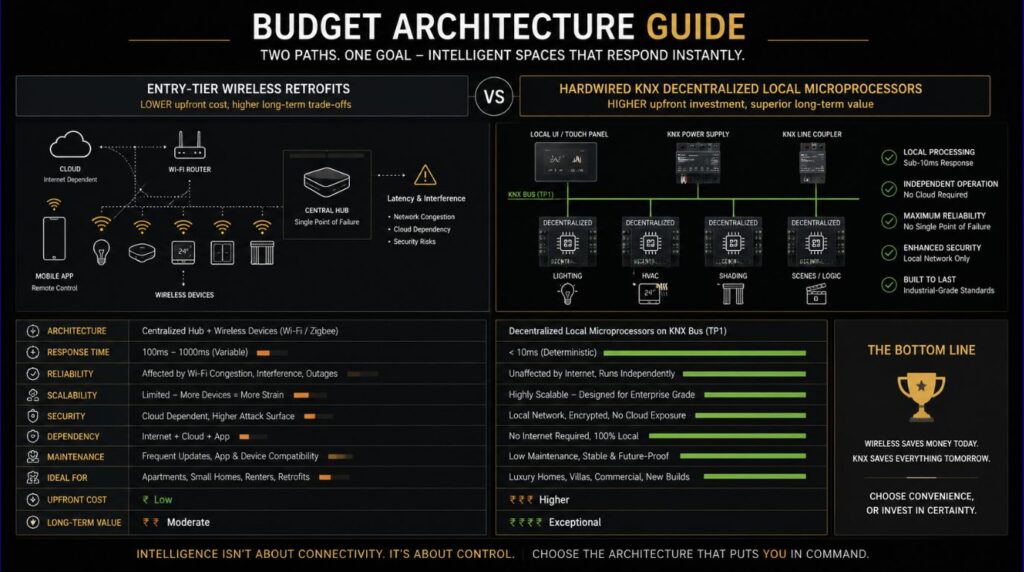
| Technical & Operational Parameter | Entry-Tier Consumer Retrofit | Enterprise Architectural Infrastructure (KNX) |
| Navi Mumbai Price Range Estimate | ₹1.5 Lakhs – ₹4 Lakhs (Piecemeal) | ₹5 Lakhs – ₹25 Lakhs+ (Whole-Home Base) |
| Physical Wiring Architecture | Existing analog loop lines | Centralized Low-Voltage Star Topology |
| Signal Transmission Method | Volatile airborne radio frequencies | Pristine Shielded Physical Bus Cable |
| System Processing Logic | Public internet cloud dependency | 100% Decentralized Local Microprocessors |
| Average Whole-Home Energy Savings | 5% to 12% (Highly inconsistent) | 30% to 50% (Verified operational savings) |
| Electrical Surge Resilience | Vulnerable (Prone to terminal frying) | Panel-Level Sequence Power Staggering |
| Structural Hardware Lifespan | 3 to 5 years (Rapid product aging) | 30+ Years (Engineered to match concrete frame) |
Protecting Your Technology Investment Against Municipal Grid Surge Risks
In coastal real estate environments like Navi Mumbai, the single most dangerous moment for your home’s luxury electronics is the exact millisecond municipal grid power returns after an unannounced monsoon blackout. The sudden, intense inrush current surge can instantly fry the delicate circuit boards of imported kitchen appliances, expensive VRF compressors, and high-end LED downlights.
I eliminate this massive financial risk by building intelligent, industrial-grade power recovery logic right into our centralized electrical distribution panels. Instead of allowing your property to draw maximum current all at once when power is restored, our panel-mounted actuators safely delay and stagger high-load electrical loops online, sequence-by-sequence over several seconds, shielding your entire hardware investment from terminal electrical damage.
Elevating Your Property from a House of Moving Parts to an Invisible Asset
Building or renovating a premium estate in Navi Mumbai is a significant long-term investment meant to secure a peaceful, permanent sanctuary for your family. If your modern conveniences constantly force you to debug frozen wireless routers, look at messy dangling power blocks, or pay regular technical fees to track down dropped signals inside your walls, your technology has transformed from a premium comfort into an operational liability.
At Techtastic, we don’t look at smart homes through a superficial retail lens. We engineer robust, industrial-grade building backbones that treat automation as an enduring architectural asset, completely on par with world-class MEP engineering. We handle the hidden low-voltage pathways, physical panel dynamics, and hardware interlocks that allow you to stop managing your home’s technology and finally start experiencing true environmental comfort.
🤝 The Partnership Corner
- For Health-Conscious Homeowners: We step directly into your raw design phase to engineer an unshakeable, offline-first automation blueprint that eliminates long-term technical surprises, battery tracking, and expensive civil reworks.
- For Luxury Architects & Interior Designers: We coordinate seamlessly during your gray-structure phase, providing precise electrical wiring schematics, panel calculations, and conduit maps to keep your physical layouts completely immaculate.
Let’s build a digital foundation engineered to endure for generations.
📞 Call/WhatsApp: 9769145145
📍 Engineering Unshakeable Reliability Across: Navi Mumbai | Nashik | Lonavla | Sangli
Technical FAQs on Smart Home Installation Cost
Q: Why does a professionally hardwired smart home installation cost more than wireless smart switches?
A: A professional hardwired smart home installation cost is more as it requires a higher initial investment because it replaces traditional analog loop lines with a centralized star-topology framework. Every single lighting circuit, climate zone, and motorized track routes through dedicated conduits straight back to your main electrical panel, utilizing industrial-grade DIN-rail actuators and safe, low-voltage physical bus cabling instead of cheap, fragile plastic wireless modules.
Q: Can a professionally integrated smart home system help lower my monthly electricity bills?
A: Yes. Engineering data verifies that an integrated hardwired automation backbone reduces a property’s overall energy footprint by 30% to 50%. It achieves this by cross-linking separate sub-systems over a single control layer—automatically dropping climate loads in empty rooms, dimming lights via closed-loop daylight harvesting, and cutting power to standby appliances at the relay level to stop vampire power drain.
Q: Is it possible to deploy a hardwired KNX automation framework inside a finished apartment?
A: Deploying a hardwired KNX framework is highly efficient during the raw civil shell or core renovation stage, as it requires laying out dedicated low-voltage data conduits before walls are plastered. If your apartment is already finished and painted, running a hardwired system would require breaking open finished ceilings and masonry to route the physical green bus wire, making early structural planning essential.