
Summary
The most expensive smart home installation mistakes stem from treating automation as a surface-level software choice rather than core electrical infrastructure. Homeowners lose substantial capital by relying on consumer-grade wireless hardware that chokes inside reinforced concrete walls, failing to run a dedicated low-voltage cable backbone during the raw construction phase, and installing locked, proprietary ecosystems with a 3-to-5-year obsolescence window. To protect your smart home installation investment, your system must utilize an open-protocol, hardwired standard (like KNX) that operates completely offline, isolates circuits natively against grid voltage surges, and scales over 30 years without requiring structural re-drilling.
The Crores Slid Down the Conduit: The Hidden Financial Bleeding of an Afterthought Automation Plan
I recently stepped into a breathtaking, newly constructed three-story villa in Lonavla. The owner, a meticulous businessman, had invested heavily in Italian marble, high-end HVAC systems, and custom designer furniture. But as we stood in the main distribution room, his voice was filled with deep regret. He had just received a quotation to completely tear out the freshly plastered drywall in his formal living room.
Why? Because his automation installer had relied on a consumer wireless setup that simply could not push signals through the home’s 9-inch thick reinforced concrete structural beams. To make his smart lighting and security systems responsive, he was faced with a nightmare scenario: either accept a home plagued by dropouts and lag, or pay lakhs in destructive civil rework to retroactively pull physical communication cables.
This is the financially draining “Automation Exile” that captures ambitious homeowners completely off guard. You treat smart technology as a minor finish—like a coat of paint or a piece of loose furniture—only to realize too late that it is a permanent, complex smart home installation mechanical system.
The “Industry Wound” is the retail lie told by mass-market consumer brands: that you can flawlessly automate a multi-crore estate using cheap, out-of-the-box wireless gadgets and a few smart plugs. They hook you with low upfront product costs, but hide the brutal engineering truth. Sprawling properties constructed with dense concrete, local stone, and low-E metallic window glazing create a hostile environment for wireless signals. When commands drop, batteries die silently inside walls, and proprietary cloud apps go obsolete, your initial savings vanish into an endless cycle of technical support fees, hardware replacements, and structural patches.
True luxury is an invisible, unshakeable utility that protects your time and your bank account. Avoiding catastrophic smart home installation mistakes and financial leaks requires moving past superficial retail gadgets and grounding your property in a professionally engineered, hardwired blueprint before the first layer of plaster is applied.
What are The Most Expensive Smart Home Installation Mistakes to Avoid During Construction?
The most expensive smart home installation mistakes to avoid during construction are failing to lay a dedicated low-voltage bus cable alongside your high-voltage lines and omitting separate, dedicated conduit tracks for data communication during the raw gray-structure phase. Skipping this critical infrastructure layout forces you to choose between highly unreliable wireless networks or paying for destructive, costly civil work to break down the line.
The Failure to Run a Hardwired Backbone
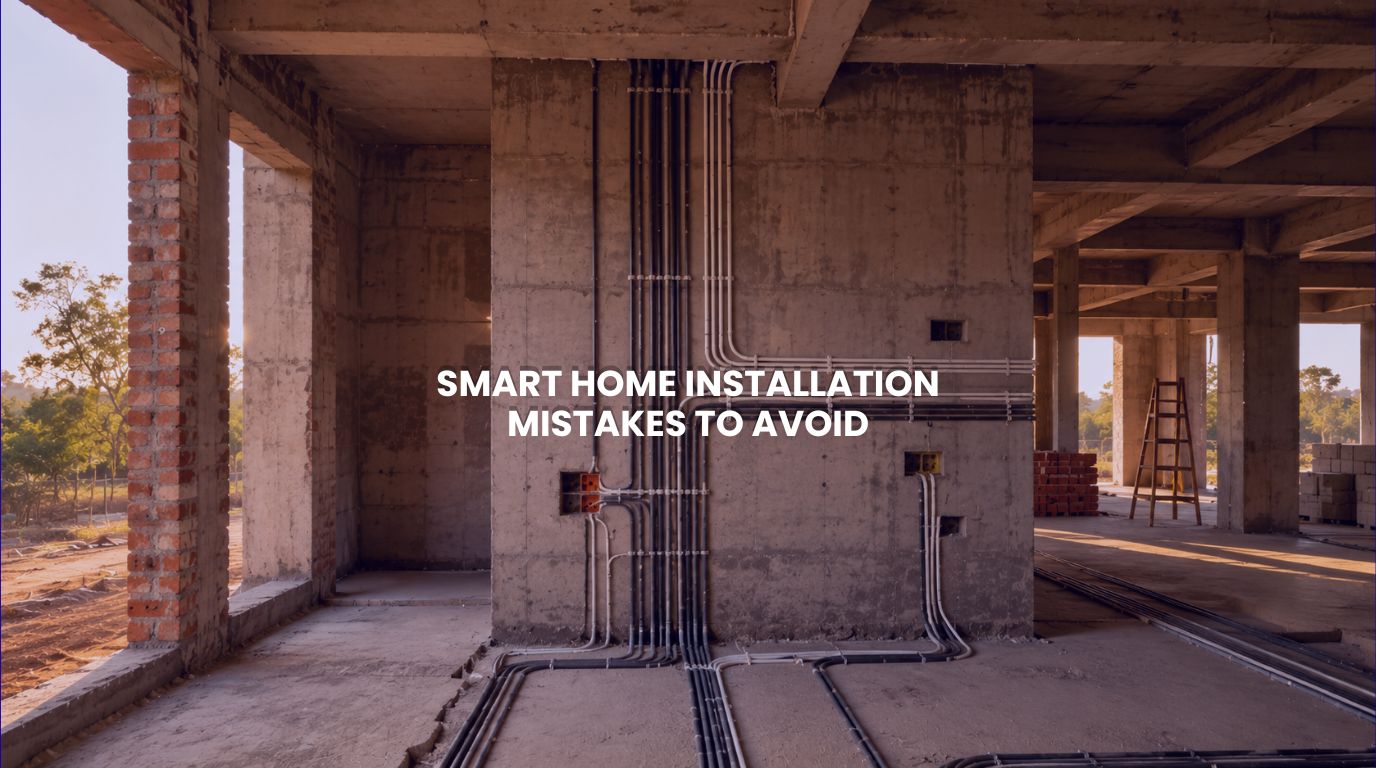
When a luxury villa is in its raw brickwork stage, running cables is relatively inexpensive. The catastrophic smart home installation mistake occurs when homeowners assume wireless routers will handle everything.
Without a physical low-voltage green bus cable connecting every switchboard, climate valve, and motorized blind directly back to a centralized electrical distribution panel, you lose the ability to deploy enterprise-grade automation. Retrofitting a physical cable infrastructure after the premium plaster, paneling, and Italian marble are installed can easily quadruple your total technology spend.
Crowding High-Voltage and Data Conduits
Another massive financial pitfall is pulling low-voltage data lines (like Cat6 or automation bus wires) through the same plastic conduits as your heavy 230V mains power lines. High-voltage lines generate intense electromagnetic fields that induce electrical noise and signal corruption on adjacent data lines.
This smart home installation oversight leads to intermittent system crashes and “ghost commands” where lights trigger randomly at midnight. Resolving this issue requires completely repulling the compromised wires through separate, isolated conduit paths at a massive labor expense.
How Do Wireless Smart Home Installation Systems End Up Costing More Than Hardwired Installations?
Wireless smart home installation systems end up costing more than hardwired installations over time because consumer wireless hardware suffers from a rapid 3-to-5-year software obsolescence window, requires high ongoing maintenance for battery replacements, and reduces your property’s structural valuation. Hardwired systems function as architectural utilities that last for over 30 years without requiring structural overhauls.
The Lifecycle Trap of Rapid Obsolescence
Consumer-grade wireless smart home installation devices are treated by their manufacturers as disposable consumer electronics, much like smartphones. When a mass-market brand decides to shut down its regional cloud servers or stops updating its proprietary mobile application, your entire array of wireless switches and bridges becomes completely useless overnight.
Hardwired industrial standards (such as KNX) are globally recognized open protocols supported by over 500 independent international manufacturers. If one brand stops producing a module, a component from a completely different manufacturer can be snapped onto the rail as a direct replacement, protecting your foundational capital asset indefinitely.
The Accumulated Cost of Maintenance Vampires
A sprawling luxury villa can easily house between 80 and 150 automated points, including occupancy sensors, door contacts, and glass-break detectors. If these units are wireless, they rely heavily on internal lithium batteries.
The recurring cost of hiring technical teams to continuously diagnose system dropouts, scale wireless mesh repeaters, and replace hundreds of dead batteries hidden inside ceilings creates an ongoing operational expense that quickly overtakes the one-time initial investment of a hardwired, continuous low-voltage bus power line.
Why Does a Lack of Professional MEP Coordination Cause Smart Home Budget Overruns?
A lack of professional Mechanical, Electrical, and Plumbing (MEP) coordination causes budget overruns because, without unified engineering blueprints, separate contractors install conflicting subsystems that work against each other, leading to hardware damage and expensive field corrections.
The Clash Between HVAC and Automation Actuators
When your automation integrator does not sit down with your HVAC consultant during the panel design phase, the home’s climate controls and automated ventilation units operate blindly on completely separate loops.
For instance, your under-floor radiant heating system might actively fight your centralized VRF air conditioning compressor in the same room, resulting in astronomical electricity bills and premature motor burnouts. Professional MEP integration ensures that a single, unified wall sensor manages both heating and cooling through locked, intelligent interlocks.
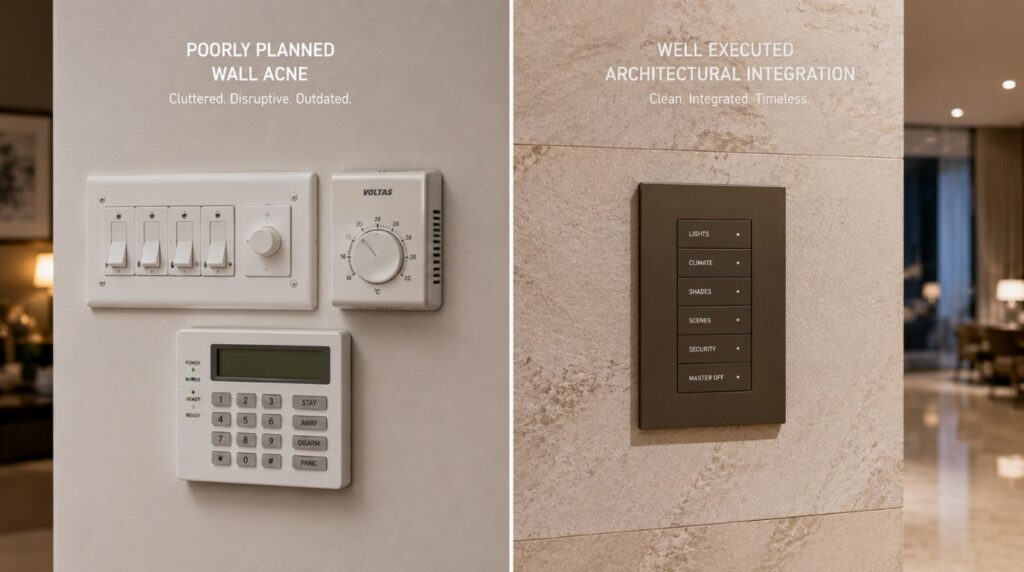
The Nightmare of Wall Clutter and “Wall Acne”
Without coordinated engineering layout maps, your walls become a messy battleground for separate contractors. You end up with a high-voltage switchboard from an electrician, a bulky thermostat from an AC vendor, a volume knob from an audio team, and a security panel from a camera vendor, all crowded together on a premium accent wall.
Fixing this visual mess later requires throwing away mismatched hardware and purchasing unified, custom-engraved designer keypads that consolidate all these functions into a single plate.
Technical Comparison: The True Cost of Infrastructure Short-Sightedness
Looking at the mechanical differences between a shortsighted consumer setup and an industrial-grade engineering plan illustrates why cutting corners during raw building phases leads to severe financial penalties.
| Financial & Technical Impact | Surface-Level Consumer Setup | Hardwired Industrial Plan (KNX) |
| Upfront Infrastructure Capital | Low (Inexpensive retail hardware purchase) | Higher initial investment in copper & panels |
| Civil Rework Risks | Severe (High probability of breaking walls later) | Zero (Future-proof low-voltage conduits set) |
| System Lifespan Expectancy | 3 to 5 Years (Frequent protocol drops) | 30+ Years (Industrial building longevity) |
| Grid Surge Resilience | Minimal (Sensitive circuit boards burn out easily) | High (Integrated choke filters & isolation relays) |
| Long-Term Maintenance Cost | Continuous (Battery swaps & software rebuilds) | Zero-Touch (Continuous local bus power supply) |
| Real Estate Resale Valuation | Negligible (Viewed as temporary gadgets) | High (Valued as a permanent structural asset) |
Can an Incorrectly Installed Smart Home System Damage your Luxury Appliances?
Yes, an incorrect smart home installation system can severely damage your luxury appliances and premium lighting fixtures by failing to incorporate centralized panel-level surge suppressors and staggered, sequential power-up recovery programming.
The Threat of Return-Current Voltage Swells
In modern Indian urban centers, the single most dangerous millisecond for your electronic infrastructure is the exact second municipal grid power returns following a temporary blackout. The sudden rush of raw current can create a massive voltage surge that instantly destroys the sensitive circuit boards of premium LED drivers, imported kitchen appliances, and HVAC compressors.
We program hardwired automation panels to execute smart recovery paths, gently staggering your high-load circuits online over a sequence of several seconds to protect your equipment from terminal electrical arcs.
Harmonic Distortion from Cheap Switching Modules
Cheap modular smart switches jammed tightly behind traditional switchboards use low-quality mechanical relays that generate massive harmonic distortion and heat over time.
This localized electrical noise degrades the lifespan of your expensive architectural downlights, leading to premature lamp failure, humming transformers, and a constant, expensive stream of replacement orders. Premium hardwired actuators utilize heavy-duty, panel-mounted isolation relays that cleanly cut current without generating destructive harmonics.
Transitioning From a Collection of Fragile Tech Toys to an Unshakeable Legacy
Building or renovating a premium estate is a labor of love meant to establish a permanent sanctuary for your family. If your automated home forces you to routinely debug frozen routers, apologize to guests for dead switches, or pay for structural wall repairs, the technology has transformed from a luxury into an operational liability.
At Techtastic, we don’t look at home automation as a superficial collection of trendy gadgets or retail boxes. We engineer robust, industrial-grade building backbones designed to withstand the harsh realities of local environmental and grid challenges. We design the silent, permanent digital foundations that safeguard your capital, maximize your property’s value, and allow you to finally experience your home with absolute peace of mind.
🤝 The Partnership Corner
- For Discerning Villa Owners: We step in during your design phase to engineer an unshakeable, offline-first automation roadmap that eliminates smart home installation mistakes, financial surprises, and structural reworks.
- For Luxury Architects & MEP Consultants: We collaborate directly with your technical teams, providing precise wiring schematics, conduit maps, and panel load calculations to ensure your structural design remains pristine and flawless.
Let’s secure your property investment against expensive smart home installation mistakes.
📞 Call/WhatsApp: 9769145145
📍 Engineering Unshakeable Reliability Across: Navi Mumbai | Nashik | Lonavla | Sangli
Technical FAQs on Smart Home Installation Mistakes
Q: What are the most expensive smart home installation mistakes to avoid during construction?
A: The most financially damaging smart home installation mistakes are failing to install a dedicated low-voltage green bus cable during the raw brickwork phase and forcing data wires and high-voltage electrical lines into the same conduit tracks. These smart home installation errors lead to severe signal corruption, ghost commands, and eventually force homeowners to undergo expensive civil breaking and wall reconstruction to run corrective wiring later.
Q: How do wireless smart home systems end up costing more than hardwired installations?
A: Wireless setups carry deceptive long-term costs due to a short 3-to-5-year software obsolescence window, where consumer electronics brands routinely discontinue cloud server support and apps. Additionally, the constant labor expense of tracing dropped mesh networks and replacing hundreds of dead batteries inside wireless sensors quickly overtakes the upfront cost of a permanent, hardwired architectural utility engineered to last over 30 years.
Q: Can an incorrectly installed smart home system damage your luxury appliances?
A: Yes. Cheap or poorly integrated smart home installation systems lack panel-level surge suppressors and sequential power-up recovery scripts. When municipal grid power abruptly returns after a blackout, the resulting sudden voltage swell can easily burn out sensitive electronic components inside high-end LED drivers, VRF air conditioning modules, and premium appliances. Hardwired smart home installation systems actively isolate and stagger these loads to ensure absolute hardware safety.