
Summary
When comparing a DIY smart home vs professional installation, DIY setups excel in low upfront costs and simple plug-and-play functionality for small apartments, while professional installation is required for large architectural estates demanding 100% reliability, security, and structural integration. DIY relies heavily on wireless consumer gadgets vulnerable to network failure and high maintenance. Conversely, a professional installation utilizes hardwired, open-protocol infrastructures like KNX or Control4, delivering an offline-first, future-proof utility that operates seamlessly across dense concrete structures without the burden of constant manual troubleshooting or battery changes.
The Smart Light Epiphany: Why a Weekend Passion Project Can Hijack Your Peace of Mind
I recently sat in the study of a sweeping, newly built bungalow in Sangli. The owner, a brilliant tech-savvy engineer, had spent three consecutive weekends meticulously installing DIY wireless smart switches, syncing them with retail motion sensors and multiple smartphone applications. He looked at me, completely exhausted, and confessed that his family was on the verge of a mutiny. The kitchen lights required a three-second delay to activate, the main gate camera kept dropping off the mesh network, and his wife had just spent ten minutes trying to bypass an app update just to turn on the geyser.
This is the classic “DIY Exile” that catches ambitious homeowners completely off guard. You approach automation as a fun, weekend customization project, but you end up operating a fragile, localized tech support helpdesk for your own family.
The “Industry Wound”—the mass-market lie broadcast by consumer retail giants—is that a reliable, whole-home automation ecosystem can be built cheaply using wireless retail gadgets and a handful of downloaded applications.
They sell you on “simplicity,” but hide the core engineering reality of large Indian estates. A luxury home constructed with heavy brickwork, dense concrete slabs, and complex multi-zone HVAC systems is a hostile environment for consumer-grade wireless devices. When software updates break your custom scripts, or device batteries die silently inside your walls, your dream of effortless living turns into a permanent, frustrating chore.
True luxury is an unshakeable, enterprise-grade utility that demands absolutely none of your spare time. It requires moving past the trial-and-error of DIY gadgets and anchoring your property to a professionally engineered foundation.
Comparison: DIY Smart Home vs Professional Installation?
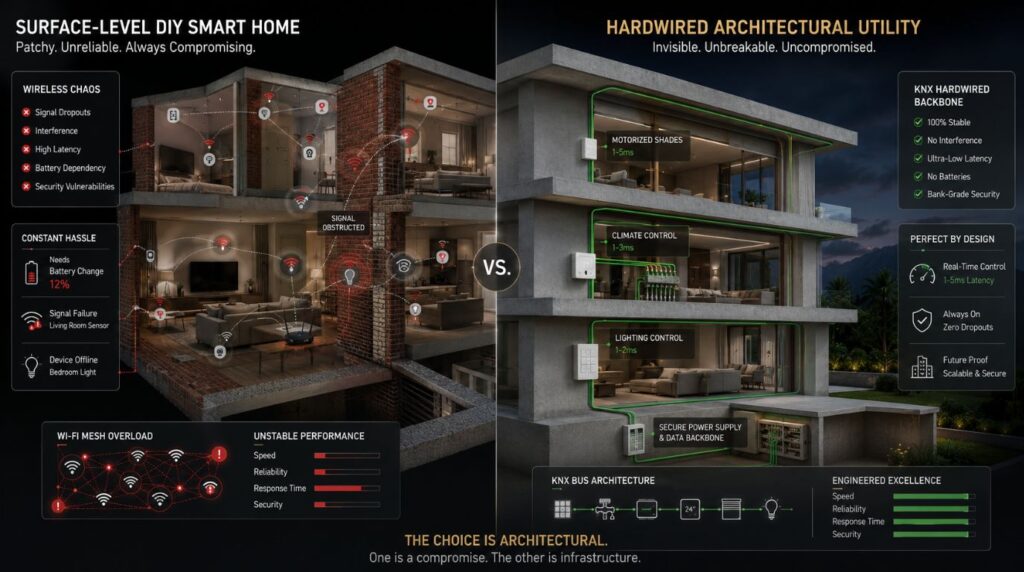
The main difference between a DIY smart home vs professional installation is that DIY systems are built using consumer-grade wireless devices that process commands through cloud servers and individual apps, whereas professional installations utilize industrial-grade, hardwired protocols like KNX that process data locally and natively across a unified architectural infrastructure. This fundamental engineering divide directly impacts the system’s lifespan, reliability, and maintenance requirements.
The Structural Infrastructure Divide
Upon comparing DIY smart home vs professional installation, you can see that the DIY setups adapt to the finished surface of a home, relying entirely on the existing electrical wiring and an airborne Wi-Fi or Zigbee radio network. A professional system integrator cuts deep into the “Gray Structure” stage of construction, laying down a dedicated physical backbone—like a shielded green bus cable—that weaves every switch, climate valve, and motorized shade into a single, cohesive mechanical nervous system.
Cloud Dependence vs. Local Sovereign Logic
When you trigger a DIY smart bulb, your command typically bounces from your phone, out to a regional cloud server across the ocean, and back to your router to execute. A professional installation keeps 100% of its foundational logic entirely offline. Because the intelligence is decentralized across localized hardware modules, your lights, shading, and security execution occur in single-digit milliseconds—completely immune to external internet blackouts.
What are the Pros and Cons of Building a DIY Smart Home?
The primary pros of a DIY smart home are low initial entry costs, highly accessible retail availability, and the flexibility to add or modify individual gadgets without professional assistance; however, the critical cons include severe signal degradation through concrete walls, a strict dependency on continuous internet connectivity, and a high long-term maintenance burden.
The Pros: High Flexibility for Minor Spaces
For a rented apartment, a temporary property, or a single-room media setup in Navi Mumbai, DIY is an excellent choice. It allows you to test the waters of automation using plug-in modules, smart LED bulbs, and universal IR blasters without modifying your landlord’s electrical panels or drilling into structural walls.
The Cons: The Fragile “Walled Garden” and Battery Fatigue
As you scale a DIY system past ten or fifteen devices, the architecture begins to fracture. Conflicting wireless protocols fight for local IP addresses, and you are forced to jump across multiple fragmented apps just to manage the space. Furthermore, consumer sensors are “maintenance vampires,” running on small lithium coin batteries that require constant replacement across a sprawling property, leading to severe system downtime when a battery dies unnoticed.
Why Should You Choose Professional Smart Home Integration for Luxury Villas?
You should choose professional smart home integration for luxury villas because it guarantees absolute operational reliability through hardwired open protocols, eliminates aesthetic clutter by replacing bulky switchboard arrays with elegant single-keypads, and scales flawlessly across vast distances without signal degradation. Professional integration treats smart technology as a permanent building utility, akin to premium plumbing or high-end HVAC engineering.
Bypassing the Concrete Radio Sponge
Independent premium bungalows in India feature dense reinforced concrete and heavy brick profiles that heavily absorb and deflect wireless signals. A professional hardwired installation completely bypasses airborne radio vulnerabilities by transmitting data over shielded, physical low-voltage lines inside your walls, delivering unshakeable stability through every season and monsoon storm.
Eradicating “Wall Acne” Completely
A major drawback of a piecemeal DIY approach is the accumulation of messy, mismatched switches, thermostats, and manual volume knobs crowding your walls. Professional integrators unify all these disparate systems. A single, custom-engraved designer keypad from elite manufacturers like Basalte or Ekinex handles lighting scenes, climate levels, and audio zones simultaneously, keeping your architectural interior pristine.
How do the Long-Term Costs of DIY Smart Home and Professional Automation Compare?
While a DIY smart home features an incredibly low upfront purchase price, its long-term costs are highly deceptive due to rapid hardware obsolescence, frequent component failures, and the recurring necessity to completely replace deprecated wireless ecosystems every 3 to 5 years. A professional KNX-based installation requires a significant initial capital investment but offers an extraordinary lifecycle return, operating flawlessly for over 30 years without requiring structural overhauls or brand-locked hardware replacements.
| Core Evaluation Matrix | Consumer DIY Automation | Professional Hardwired Installation |
| Primary Infrastructure | Wireless (Wi-Fi, Zigbee, Bluetooth) | Shielded Physical Bus Cable (KNX Standard) |
| System Lifespan | 3 to 5 Years (Rapid Obsolescence) | 30+ Years (Industrial Engineering Grade) |
| Operational Security | Vulnerable to Wireless Interception | Air-Gapped, Physical Local Security |
| Maintenance Profile | High (Frequent Reboots & Battery Swaps) | Zero-Touch (Continuous Bus Power Supply) |
| Property Valuation | Negligible (Viewed as Temporary Gadgets) | Tangible Capital Asset (Architectural Utility) |
Transitioning from a House of Gadgets to an Unshakeable Sanctuary
Building a luxury home is an exercise in creating an enduring legacy for your family. If your automated systems require you to routinely reset routers, swap out dead batteries, or apologize to guests for a light switch that won’t respond, the technology has failed you.
At Techtastic, we step in to eliminate that friction. We don’t sell superficial, out-of-the-box tech toys; we engineer the silent, heavy-duty, and unshakeable digital foundations that allow you to stop managing your home and finally start experiencing it as a true guest.
🤝 The Partnership Corner
- For Discerning Homeowners: We take over the technical burden completely, delivering a unified, seamless living environment custom-tailored to your lifestyle routines.
- For Luxury Architects & Designers: We coordinate seamlessly during your raw brickwork and gray-structure phase to ensure your minimalist vision remains entirely free of technological clutter.
Let’s build a foundation that endures.
📞 Call/WhatsApp: 9769145145
📍 Engineering Seamless Luxury Across: Navi Mumbai | Nashik | Lonavla | Sangli
Technical FAQs
Q: What is the difference between a DIY smart home vs professional installation?
A: DIY smart homes rely on superficial consumer wireless devices that process data via the cloud and separate consumer applications, making them highly vulnerable to signal drops. Professional installations use enterprise-grade, hardwired architectures (like KNX) that process all automated logic locally and offline over physical cables for absolute reliability.
Q: What are the pros and cons of building a DIY smart home?
A: The pros include an accessible entry cost and easy setup for small, temporary, or rented rooms. The cons are severe signal blockages caused by thick concrete walls, a high long-term maintenance requirement due to constant battery replacements, and lag during internet or router disruptions.
Q: Why should you choose professional smart home integration for luxury villas?
A: Professional integration is essential for luxury estates because it utilizes a shielded, hardwired backbone completely immune to wireless interference. It condenses cluttered switchboards into elegant, unified keypads and integrates heavy HVAC, lighting, and security into a single, permanent building utility that lasts for decades.