
Summary
Yes, a KNX system is exceptionally reliable during power outages because its decentralized architecture stores programming locally on individual hardware modules, eliminating data loss. When the main power grid fails, the KNX system retains its configuration instantly and boots up seamlessly in milliseconds once auxiliary power (like an inverter, UPS, or generator) kicks in. Unlike wireless smart homes that suffer from router reboot lag, cloud disconnects, and command dropouts during power transitions, KNX provides uninterrupted local building control, making it the most stable automation backbone for handling unpredictable power grids.
The Pitch Black Panic: Why a Simple Power Cut Can Paralyze a Multi-Crore Smart Villa
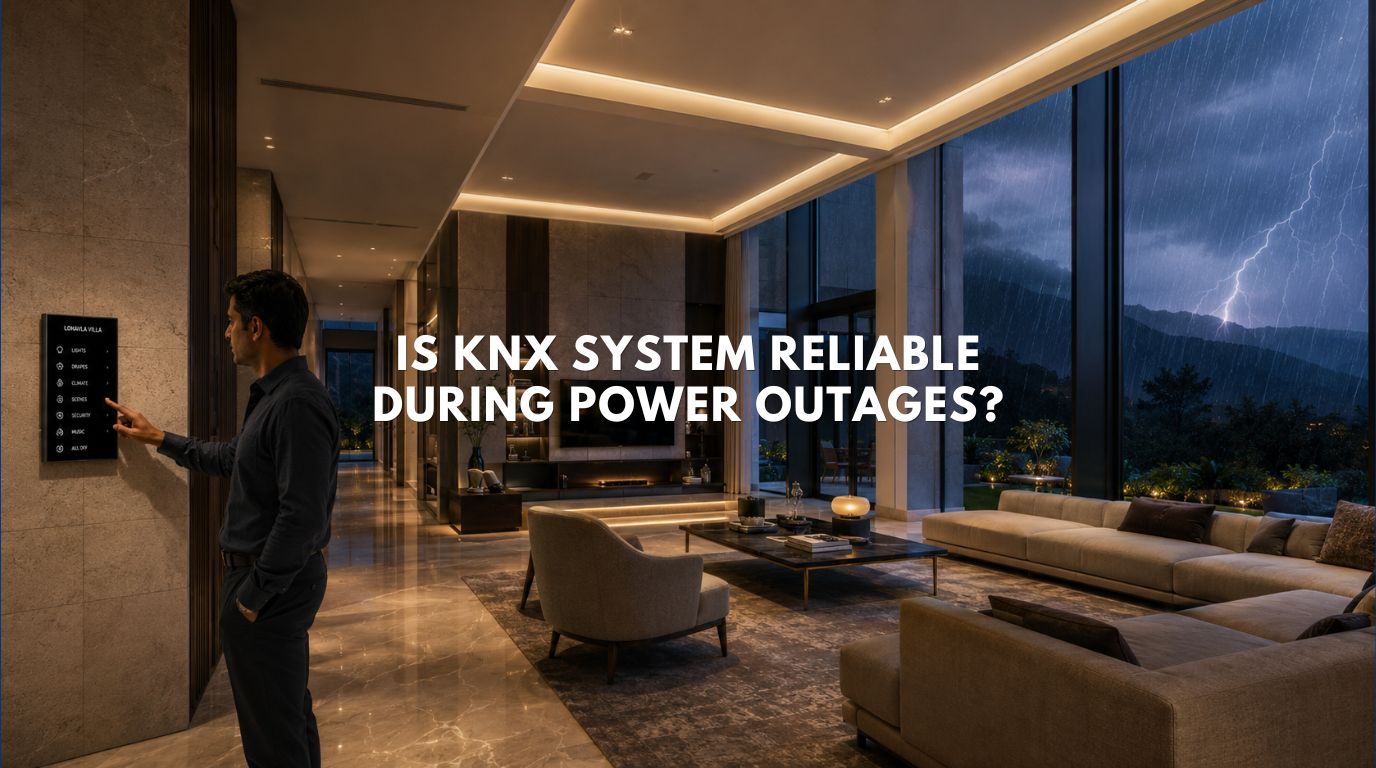
I will never forget standing inside a sprawling, ultra-luxury holiday estate in Lonavla on a stormy Friday evening. The property was a masterpiece of modern architecture, featuring lakhs worth of high-end consumer wireless smart switches and cloud-linked lighting. Suddenly, the main grid collapsed, throwing the entire house into pitch darkness. The estate’s massive backup diesel generator roared to life within ten seconds, restoring raw electrical power to the lines—but the smart home stayed completely dead.
For the next twenty minutes, the family was plunged into a “Systemic Exile.” The main internet router was stuck in a tedious reboot cycle, the wireless smart hubs were struggling to reconnect to a distant cloud server, and the wall switches simply refused to turn on a single light. The homeowners were reduced to walking around their premium property with smartphone flashlights, completely locked out of controlling their own environment.
This nightmare highlights the “Industry Wound”—the mass-market illusion that wireless, app-driven gadgets are adequate for premium estates. Mainstream automation brands sell you beautiful touch surfaces, but they hide the fatal engineering flaw: their systems are entirely dependent on a continuous internet connection and a fragile web of wireless routers. When an unstable electrical grid forces a power transition, wireless systems fracture, choke, and fail exactly when you need them most.
The truth is that your home infrastructure cannot afford to rely on the cloud. A true luxury building deserves a hardwired, offline-first nervous system that treats a power outage as a minor blip, not a total system crash. That system is KNX.
How Does a KNX System Behave When the Main Power Grid Fails?
When the main power grid fails, a KNX system enters a safe standby state where all device programming is securely preserved in non-volatile flash memory, requiring zero backup batteries to retain its configuration. Because the intelligence is decentralized across individual modules rather than inside a central server, no master database can be corrupted when the power abruptly cuts out.
The Power of Non-Volatile Flash Memory
Every KNX switch, sensor, and actuator functions as an independent mini-computer. They do not download their instructions from the internet or a central hub upon booting up. Your custom automation scenes, lighting levels, and climate parameters are burned directly into the physical hardware memory chip. When the power drops to zero, the data remains perfectly intact indefinitely.
Isolating Sensitive Circuitry Natively
The moment the voltage on the main line drops below operational thresholds, the KNX system cleanly disengages its internal relays. This mechanical isolation protects your premium architectural lighting fixtures and automated drapery motors from the destructive electrical arcs and harmonic distortions that frequently occur right at the moment a local power grid collapses.
What Happens to a KNX System When The Backup Generator or UPS Kicks in?
When auxiliary backup power from an inverter, UPS, or generator kicks in, the KNX system initializes and resumes full operational control within milliseconds, completely bypassing the need for an internet connection or a router reboot. The system instantly executes pre-programmed “Power Recovery Scenes” to safely manage your estate’s energy distribution.
Eliminating the Router Reboot Lag
In a standard Wi-Fi or wireless smart home, your backup generator might restore power in seconds, but you are still left waiting several minutes for your routers, mesh nodes, and cloud bridges to sync up. Because KNX communicates locally over a dedicated, physical green bus cable, its devices communicate the microsecond they receive electrical current. There is no loading screen, no lag, and no waiting for an IP address allocation.
Smart Load Shedding on Battery Power
When your home transitions to an emergency backup inverter or a limited solar battery bank, you cannot afford to run heavy electrical loads. KNX power supplies can read the status of your backup grid and instantly execute an energy-saving script. The system will automatically lock out heavy HVAC compressors in empty guest suites and dim architectural lights to 30%, preserving your battery bank for critical security perimeters and essential master suite circuits.
The Technical Reality of Power Transitions
| Smart Home Behavior | Hardwired KNX Standard | Consumer Wireless Wi-Fi |
| Data Retention Method | Local Non-Volatile Flash Memory | Cloud Servers / Volatile Hub Cache |
| Recovery Time to Full Control | Milliseconds (Instantaneous) | 3 to 7 Minutes (Dependent on Router) |
| System Behavior During Outage | Safe Standby State | Random Disconnects & Ghost Commands |
| Internet / Cloud Dependency | Zero (100% Local and Offline) | Absolute (Fails Without Active Web) |
| Hardware Protection | Built-in Surge/Isolation Relays | Vulnerable to Power Surge Burnouts |
Can KNX Systems Protect Expensive Smart Home Hardware from Voltage Surges?
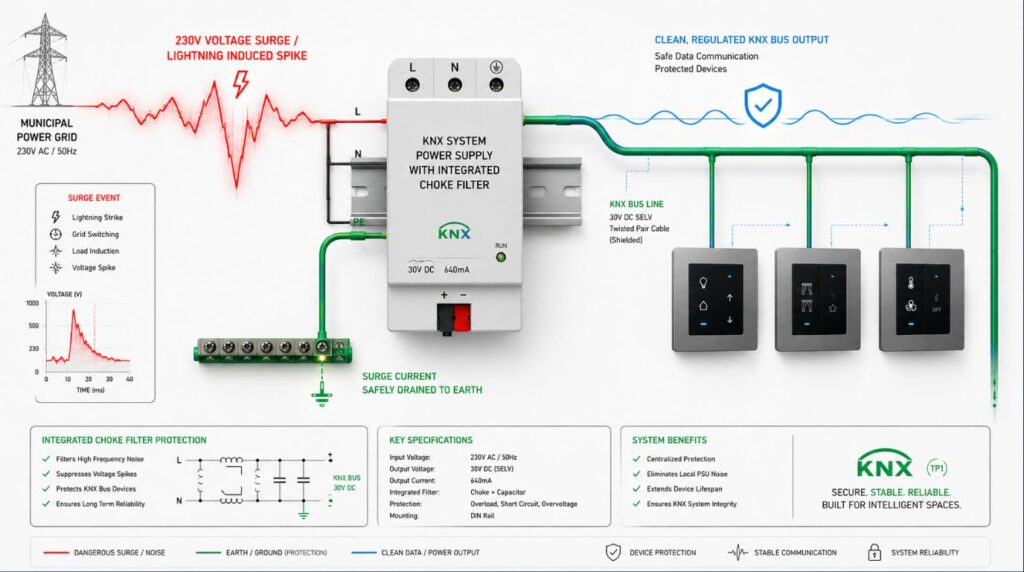
Yes, KNX systems actively protect expensive smart home hardware from voltage surges through specialized, centralized KNX bus power supplies equipped with integrated choke filters and voltage-limiting suppressors. These industrial-grade components absorb massive electrical spikes, ensuring that voltage fluctuations from the municipal grid never reach your luxury keypads or automation modules.
The Shielding of the Green Bus Cable
The iconic green KNX cable is heavily shielded and twisted to reject electromagnetic interference (EMI) and radio frequency noise. When a local transformer blows or lightning strikes nearby lines, the physical shield drains away the induced voltage spike safely to the earth terminal, keeping the communication lines clean and preventing data corruption across your hardware ecosystem.
Sequential Power Restoration Logic
One of the most dangerous moments for an architectural villa is the exact second the main grid power returns. The sudden rush of current can create a massive voltage swell that destroys modern LED drivers and appliance circuit boards. We program KNX systems to execute a staggered, sequential power-up sequence. Instead of turning on the entire estate at once, the system gently brings circuits online over a sequence of seconds, protecting your infrastructure from corporate grid instability.
Transitioning From Fragile Gadgets to An Unshakeable Infrastructure
A home that leaves you in the dark while it waits for a router to reboot isn’t smart—it’s a liability. True luxury means having absolute confidence that your environment will protect you, stabilize your infrastructure, and respond instantly, regardless of what is happening to the municipal power grid outside your walls.
At Techtastic, we don’t look at home automation as a collection of fragile tech toys. We engineer robust, industrial-grade building backbones designed to withstand the harsh realities of local environmental and electrical challenges.
🤝 The Partnership Corner
- For Electrical Consultants & MEPs: We coordinate directly with your team during the panel design phase to map out perfect surge protection and load-shedding parameters.
- For Luxury Estate Owners: We design offline-first, unshakeable automation frameworks that keep you in complete control of your sanctuary through any storm.
Let’s secure your estate against the unpredictable.
📞 Call/WhatsApp: 9769145145
📍 Engineering Unshakeable Reliability Across: Navi Mumbai | Nashik | Lonavla | Sangli
Technical FAQs on The KNX System
Q: How does a KNX system behave when the main power grid fails?
A: A KNX system enters a safe standby state where all device configurations and automation programming are securely preserved locally within individual hardware flash memories. Because it is a decentralized standard that operates without a central server, it avoids data corruption or settings loss during sudden blackouts.
Q: What happens to KNX smart homes when the backup generator or UPS kicks in?
A: The microsecond auxiliary power is restored by your backup generator or UPS, the KNX system initializes instantly and resumes full operational control within milliseconds. It operates completely offline, entirely bypassing the frustrating delays and reboot cycles associated with Wi-Fi routers and cloud servers.
Q: Can a KNX system protect expensive smart home hardware from voltage surges?
A: Yes. Centralized KNX power supplies feature built-in choke filters and surge suppressors that absorb dangerous electrical spikes. Furthermore, the system can be programmed to sequentially activate electrical circuits when grid power returns, preventing harmful voltage swells from damaging your high-end fixtures.