
Summary
Remote control curtains are a key part of modern smart homes, offering convenience, energy efficiency, and security. This blog explains how silent motors, wireless protocols, and sensors work together to go beyond basic operation. Understanding this home automation system helps homeowners and designers turn windows into smart features that improve daily life and home style.
Unlocking the Secrets Behind Remote Control Curtains: How Do They Operate?
Waking up and tapping a button to watch your heavy drapes glide open is a seamless way to let in the morning sun. It feels like living in the future, yet clever engineering grounds the reality.
In my work designing high-end homes, I have found that while many love remote control curtains, few understand how they work. Learning about these systems helps you choose a setup that lasts for decades rather than just a few seasons.
The Heart of the System: The Motorized Drive
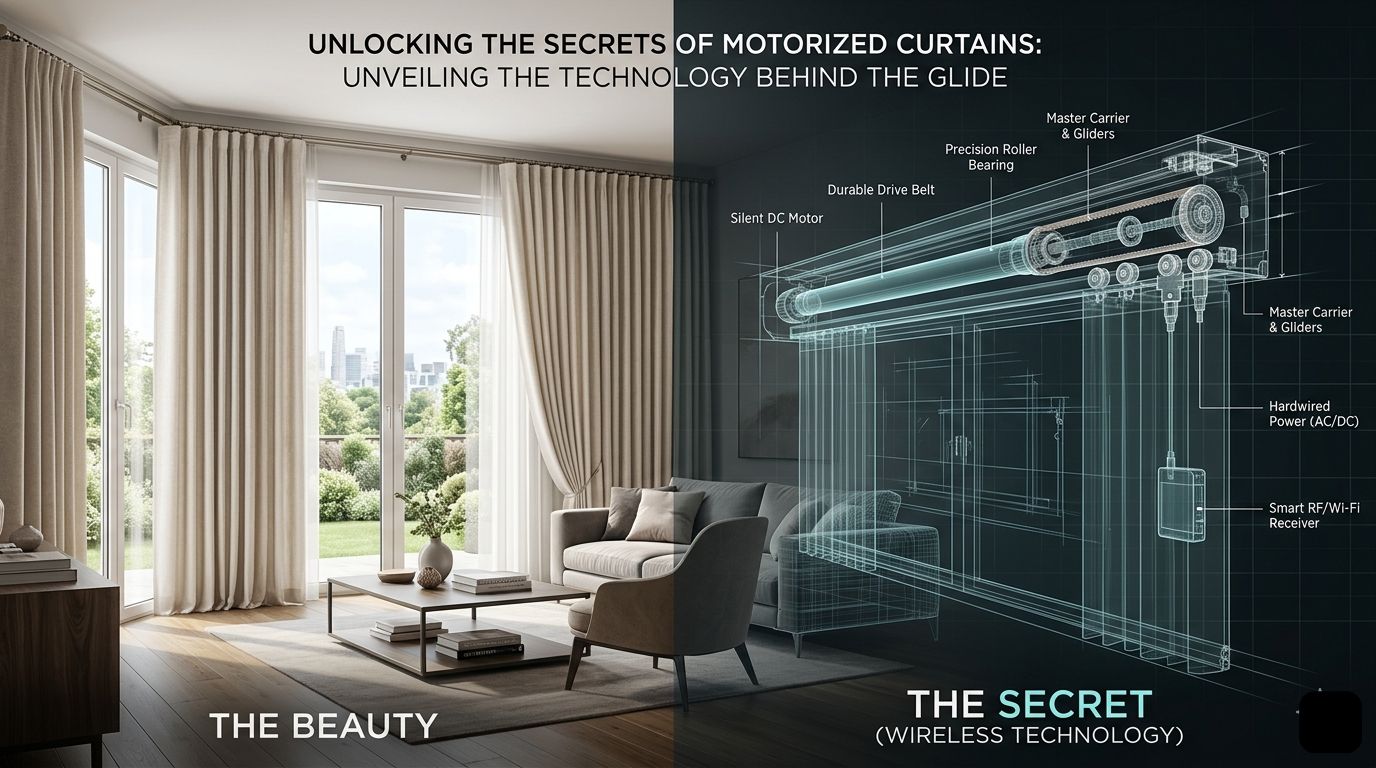
At the core of remote control curtains is the motor. These aren’t the loud, grinding motors of the past. Modern luxury systems use DC tubular motors or track-mounted motors designed for near-silent operation.
The motor converts electrical energy into mechanical motion. Inside the curtain track, there is usually a reinforced rubber or steel-core belt. The spinning motor pulls a belt attached to the “master carrier.” This lead hook then pulls the rest of your curtain fabric along the track.
Powering the Movement
One of the first questions I get is, “Do I need to tear up my walls for wires?” The answer depends on your project:
- Hardwired (AC): Ideal for new constructions. These connect directly to your home’s electrical grid. They are the most powerful and never need to be charged.
- Battery-Powered (DC): Perfect for renovations. These use rechargeable lithium-ion batteries that usually last 6 to 12 months on a single charge.
- Solar-Powered: Some systems use a small solar strip on the glass to charge the battery. This creates a virtually maintenance-free setup.
The “Remote” in Remote Control Curtains: How They Listen
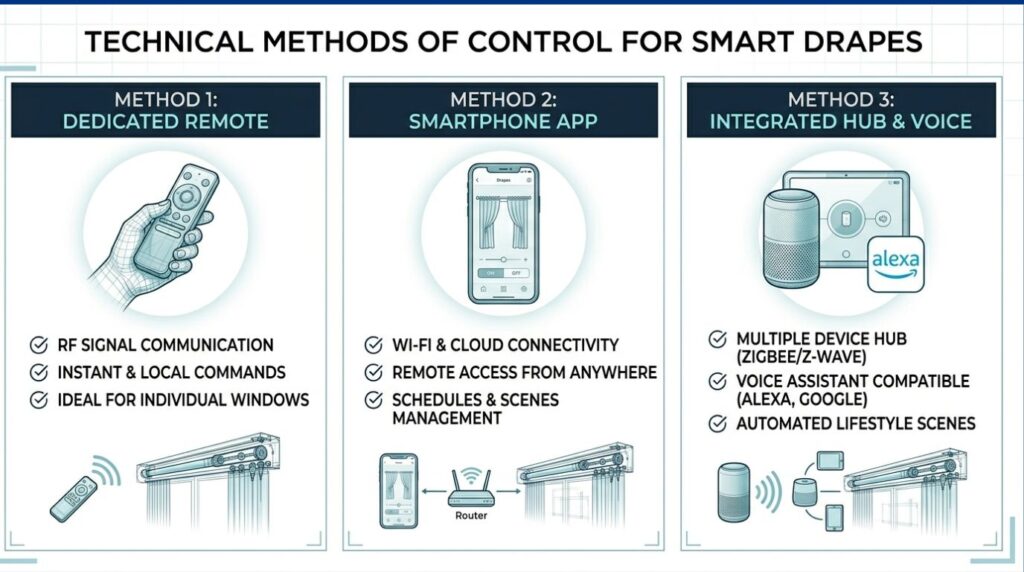
Remote control curtains are essentially a “connected” device. It needs to receive a signal to know when to move. There are three main ways this happens:
- Radio Frequency (RF): This is the most common for dedicated remotes. Unlike a TV remote (which needs “line of sight”), RF signals can travel through walls. You can be in the kitchen and close the bedroom curtains with ease.
- Infrared (IR): Older or budget-friendly systems use IR. These require you to point the remote directly at a sensor, similar to an old-school VCR.
- Wi-Fi and Zigbee/Z-Wave: This is where the real “smart” happens. You can control your curtains through smartphone apps or voice assistants like Alexa and Google Home by connecting them to your home network.
The Role of Sensors and Automation
The true “secret” to these systems isn’t the remote at all—it’s the sensors. To move past simple remote control curtains and into true intelligence, we integrate:
- Sun Sensors: When sunlight reaches a specific intensity, the curtains automatically close. This protects your furniture from UV damage and reduces air conditioning costs.
- Timers: You can program a “Vacation Mode” to open and close curtains at different times each day. This makes your home look occupied while you are away.
- Manual Override (Touch Motion): High-quality motors detect a slight pull by hand and finish the movement for you.
Why the Track Matters as Much as the Motor?
I often see homeowners focus entirely on the motor and forget the track. A cheap track creates friction, which makes the motor work harder and die sooner. Manufacturers often lubricate high-end tracks with silicone and design them with precision-grade rollers.
For heavy blackout drapes in a home cinema, the track must be strong enough to support the weight without bending. This ensures the remote control curtains always glide effortlessly.
Integrating Remote Control Curtains with Your Lifestyle
When I design these systems, I think about the “scenes.” It’s not just about one curtain. Pressing a “Goodnight” button locks the doors, dims the lights, and closes every curtain in the house at the same time. It turns a manual chore into a seamless part of your home’s rhythm.
Final Thoughts on Remote Control Curtains
Remote control curtains are often the first step into home automation because they provide immediate benefits. You’re not just buying a gadget; you’re buying back the time you spend walking around the house every morning and evening. You’re gaining a tool that manages your home’s temperature and protects your privacy.
The smart home technology is now so reliable and accessible that you can easily replace tangled cords and manual pulling. Whether it’s a sleek apartment in the city or a sprawling estate, the right motorized system makes your home feel truly alive.
Collaboration Opportunities for Builders and Architects
I work with developers, architects, and interior designers to enhance residential projects by integrating smart home technology during the planning and design stages. My team ensures that automation aligns seamlessly with your design layouts, electrical infrastructure, and interior concepts.
I invite you to partner with Techtastic to implement high-quality remote control curtains for your upcoming projects in Nashik, Navi Mumbai, Sangli, and Lonavla.
Contact Tectastic Technologies at 9769145145 for a professional consultation to see how remote control curtains can elevate your design vision.
Technical FAQs
Q: Can I motorize my existing curtains?
In most cases, yes. You don’t necessarily need new fabric, but you will almost certainly need a new motorized track or rod. You simply hook the fabric onto the new automated system.
Q: What happens if there is a power outage?
Most premium systems include a manual override. This allows you to pull the curtains by hand without damaging the motor. If you have a battery-backed system, it will continue to work normally regardless of the grid.
Q: How loud are these motors?
Quality motors operate at 30 to 40 decibels, making them as quiet as a whisper or a library. You’ll hear a faint hum, but it won’t interrupt a conversation or a movie.
Q: How much weight can a standard motor handle?
A standard residential motorized track can usually handle between 35kg and 60kg of fabric. For extra-heavy drapes or tall windows, we use two motors to double the lifting power.
Q: Is it difficult to set up the smartphone app?
If you choose a system compatible with “Matter” or “Zigbee,” the setup is as simple as adding a smart lightbulb. You scan a code, connect it to your Wi-Fi, and it appears on your dashboard.
Q: Do I need a separate remote for every window?
No. You can use a multi-channel remote to control up to 15 different curtains individually or all at once. Most people prefer using a single wall-mounted keypad or their phone.