
Summary
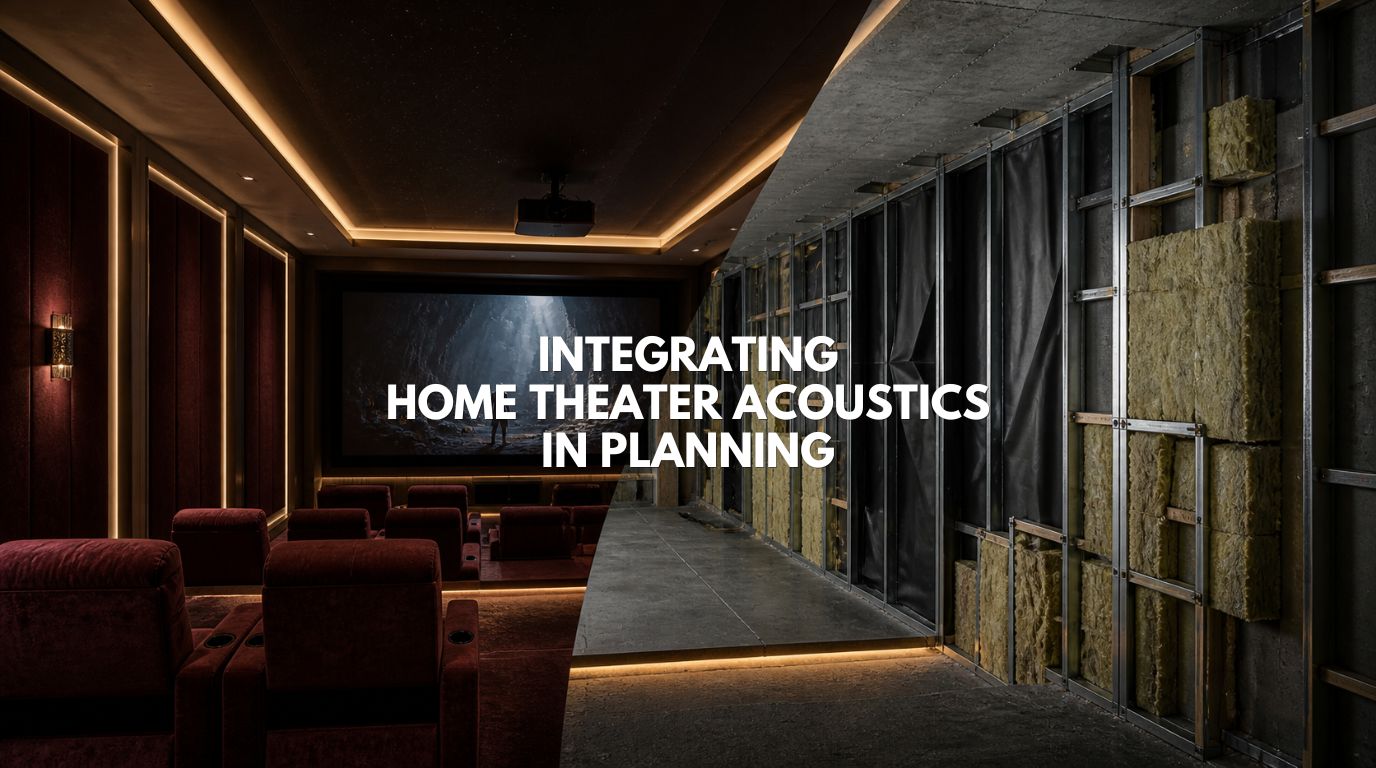
Integrating home theater acoustics during the shell stage is critical to prevent sound leakage and standing waves that ruin the immersive experience. To achieve professional-grade audio, architects must plan for room dimensions, dedicated electrical conduits, and “floating” floor or wall treatments before the plastering and interior phases begin. Early planning for acoustic insulation and speaker placement ensures a high-performance “Invisible Cinema” while avoiding the massive costs and structural compromises associated with retrofitting a finished room.
The “Beautiful Box” Disaster: Why Great Design Often Sounds Terrible
I once visited a breathtaking bungalow in Nashik where the owner had spent a small fortune on a top-tier 8K projector and imported Italian leather recliners.
The room looked like a million dollars, but the moment we turned on an action sequence, the glass windows rattled, the bass boomed uncontrollably in the corners, and his daughter in the bedroom upstairs could hear every explosion as if it were in her own room.
For years, architects and builders have lived in a state of “Acoustic Exile.” The industry has focused so heavily on the visual “Blueprints” that we’ve ignored the physics of sound. They’ve sold us a “Wound”: the lie that acoustics equals something you just stick on the walls at the end—some foam panels or a thick rug.
This mistake leads to what I call the “Beautiful Box” disaster—a room that looks like a cinema but sounds like a gymnasium. The truth is that you don’t buy true luxury home theater acoustics at a retail store; you build it into the brick and mortar during the gray structure phase.
Why Is It Important To Plan Home Theater Acoustics During The Gray Structure Stage?
Planning home theater acoustics during the gray structure stage is vital because it allows for the integration of soundproofing materials and structural modifications—like staggered stud walls or floor damping—that are physically impossible to install once the walls are plastered and finished.
By addressing acoustic concerns early, you can calculate the “Golden Ratio” for room dimensions to prevent natural echoes and ensure that heavy-duty speaker cables and conduit paths are hidden behind the structure, maintaining a clean, minimalist aesthetic while ensuring peak audio performance.
Stopping the Leak: Sound Isolation vs. Treatment
Most people confuse “soundproofing” with “acoustic treatment.” If you wait until you finish the room, you can only treat the sound inside it. To keep the sound from leaving the room—crucial for villas in Navi Mumbai or high-density luxury flats—you need to build “mass” into the shell. This means planning for double-brick walls or specialized acoustic boards during the masonry stage.
How Do Room Dimensions Affect The Sound System Quality of a Home Cinema?
Room dimensions directly affect sound quality by determining the “room modes,” which are specific frequencies that either disappear or become overbearing because of the way sound waves reflect off parallel walls.
To avoid “muddy” bass or “dead zones,” architects should avoid perfectly square rooms and instead aim for specific height-to-width-to-length ratios (such as the Sepmeyer or Louden ratios) during the initial architectural planning. Adjusting a wall by just six inches during the gray structure phase can be the difference between a crisp, professional home theater acoustics and a room that requires expensive electronic correction later.
The “Invisible” Speaker Layout
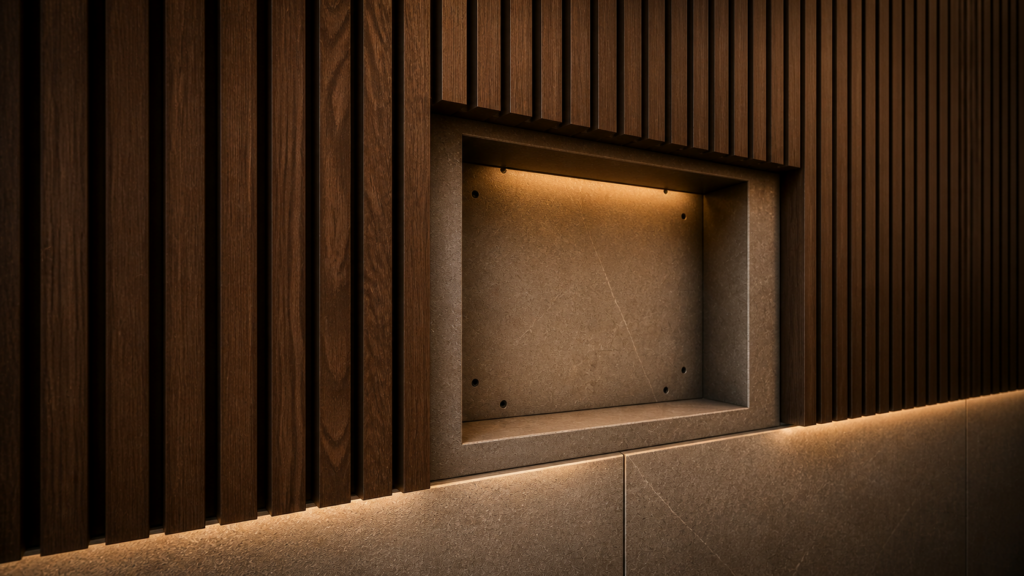
In an “Invisible Cinema,” we want the tech to disappear. During the gray structure phase, we can create “recessed niches” in the brickwork or the RCC ceiling. This allows high-end speakers to sit flush with the wall, hidden behind acoustic fabric that looks exactly like a standard painted surface.
What Electrical Infrastructure Does a High-end Home Theater Design Need?
High-end home theater acoustics require a dedicated “Clean Power” circuit, isolated from heavy appliances like ACs to prevent electronic hum, and large-diameter PVC conduits (at least 1.5 to 2 inches) to accommodate high-bandwidth HDMI and heavy-gauge speaker cables.
Planning these paths before you lay the flooring and plaster the walls prevents the need for unsightly external trunking or “hacking” into finished surfaces. In regions like Sangli and Lonavla, where power stability varies, we also plan for a centralized “UPS Nook” within the gray structure to protect expensive processors and projectors.
Bass Management in the Shell
Low-frequency sounds (the “thump” you feel) are the hardest to control. During the shell stage, we use bass traps built into architectural cavities—such as false corners or soffits—to absorb excess energy before it becomes a vibrating nuisance for the rest of the house.
🤝 The Partnership Corner
For Architects, Interior Designers, and Developers
At Techtastic, we believe that the best smart homes are built on collaboration, not just cables. We specialize in providing the technical “backbone” with home theater acoustics that allows your creative vision to shine.
- Design-First Engineering: We integrate high-end KNX wired automation and home theater acoustics into your layouts during the gray structure phase to ensure zero aesthetic compromise.
- Regional Expertise: Whether you are designing a luxury villa in Lonavla, a modern high-rise in Navi Mumbai, or a sprawling bungalow in Nashik or Sangli, our team handles the complex infrastructure so you don’t have to.
- Bulk & Project Support: We offer scalable solutions for builders and developers looking to add home theater acoustics to entire residential projects.
Let’s Build Smarter Together. Are you working on a premium project? Partner with us to elevate your design with world-class automation.
📞 Call/WhatsApp: 9769145145
📍 Service Areas: Navi Mumbai | Nashik | Lonavla | Sangli
Technical FAQs on Home Theater Acoustics
Q: Can’t I use “Acoustic Foam” later if the room sounds bad?
A: Acoustic foam only handles high-frequency reflections (like echoes). It does nothing to stop sound from traveling through walls or to fix “boomy” bass. Structural home theater acoustics handled in the gray stage are 10 times more effective than any surface-level foam.
Q: How much extra space does acoustic isolation take?
A: Generally, a professional “room-within-a-room” isolation system can take 4 to 6 inches from each wall. Planning during the gray structure lets architects adjust the footprint so the final carpet area matches the client’s expectations.
Q: Why do I need 2-inch conduits for a theater?
A: Technology changes fast. Today’s 4K HDMI cables are thick, and tomorrow’s 8K or 16K cables may be even thicker. Installing large conduits during the gray stage future-proofs the home. It lets the owner pull new cables 10 years from now without breaking a single tile.
Q. Why is it important to plan home theater acoustics during the gray structure stage?
A. Planning during the gray structure allows for structural soundproofing and hidden cabling paths that are impossible to add later. It optimizes the room dimensions to prevent natural audio distortions.
Q. How do room dimensions affect the sound quality of a home cinema?
A. Dimensions determine “room modes” or standing waves. Square rooms often create “boomy” or “muddy” sound, whereas calculated ratios planned at the blueprint stage ensure balanced, clear audio across all seats.
Q. What electrical infrastructure is needed for a high-end home theater?
A. Professional theaters need isolated power circuits to stop audio noise and large conduits for high-end cables. Installers must embed these before crews finish plastering and flooring.