
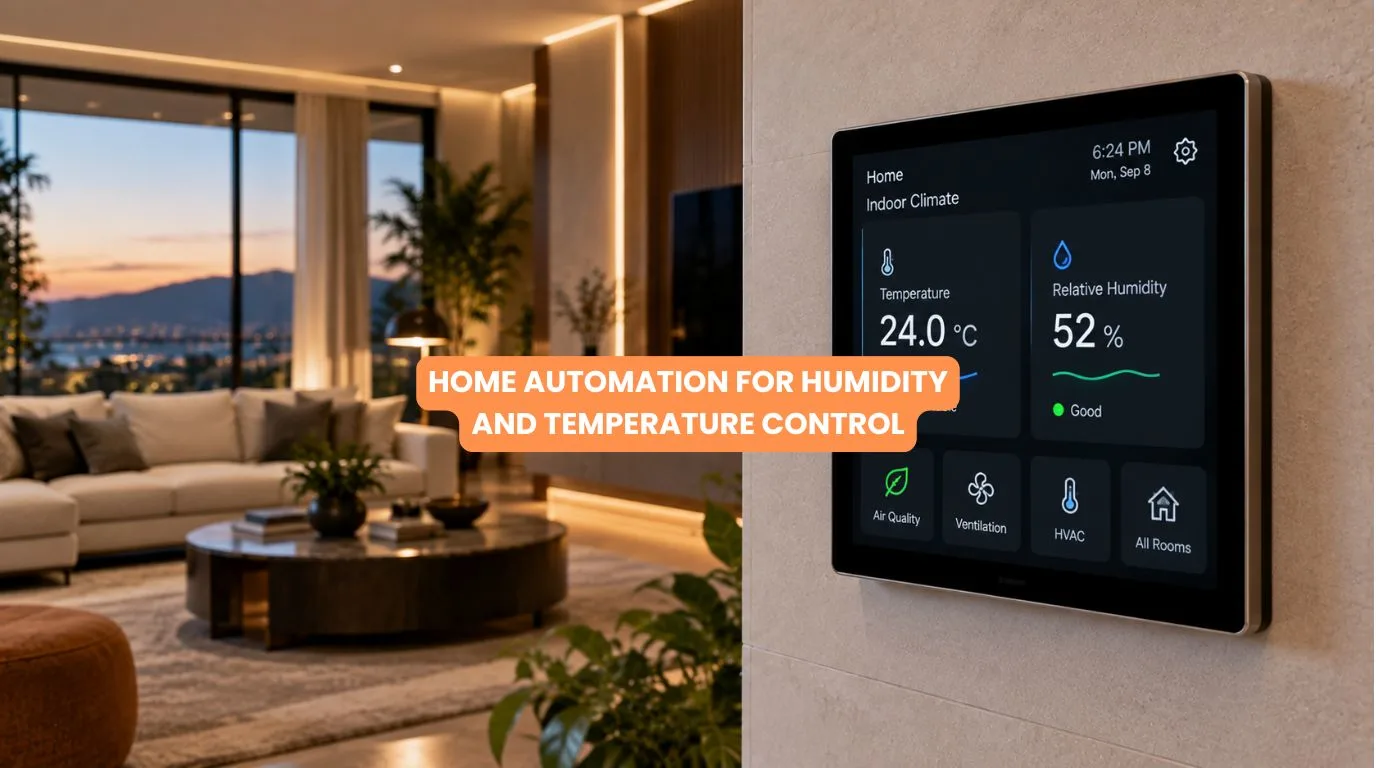
Temperature is one of the first things we notice when we enter a room. But temperature isn’t the only factor that determines whether a home feels comfortable. Humidity plays an equally important role.
A room can technically be at a comfortable temperature and still feel unpleasant if humidity is too high. Likewise, excessive cooling can make a space uncomfortable and increase energy consumption without actually improving the indoor environment. This is where home automation for humidity and temperature control adds real value.
Instead of manually changing AC settings all day, a smart home can track indoor conditions. It can also control HVAC equipment based on preset comfort needs.
For premium homes, villas, and large residences, home automation for humidity and temperature control can connect temperature sensors, humidity sensors, air conditioning, ventilation, occupancy, and other systems into a coordinated climate-control strategy. The objective isn’t simply to make the house colder or warmer.
It’s to create a more consistent indoor environment while using energy intelligently.
Quick Summary
Home automation for humidity and temperature control can help homeowners:
✓ Maintain more consistent room temperatures
✓ Monitor indoor humidity levels
✓ Automate HVAC operation
✓ Reduce unnecessary cooling and heating
✓ Adjust climate settings based on occupancy
✓ Create different conditions for different rooms
✓ Improve comfort during changing weather
✓ Integrate climate control with lighting and curtains
✓ Manage AC systems more intelligently
✓ Create personalized comfort scenes
For premium residences, the biggest advantage is coordination.
Your AC, sensors, curtains, occupancy controls, and automation system can work together instead of functioning as separate devices.
Quick Answer
Home automation for humidity and temperature control uses sensors and automation rules to monitor indoor conditions and coordinate HVAC or climate systems. For example, imagine your living room becomes warmer in the afternoon because sunlight is entering through large windows.
A well-designed system could detect the changing temperature and respond by coordinating:
- HVAC operation
- Motorized curtains
- Ventilation
- Temperature setpoints
- Occupancy settings
Similarly, humidity sensors can provide information about moisture levels inside the home.
The important distinction is that automation doesn’t necessarily mean the system continuously runs the AC. Instead, it can make climate control more responsive to actual conditions and homeowner requirements.
Why Humidity Matters Inside Your Home
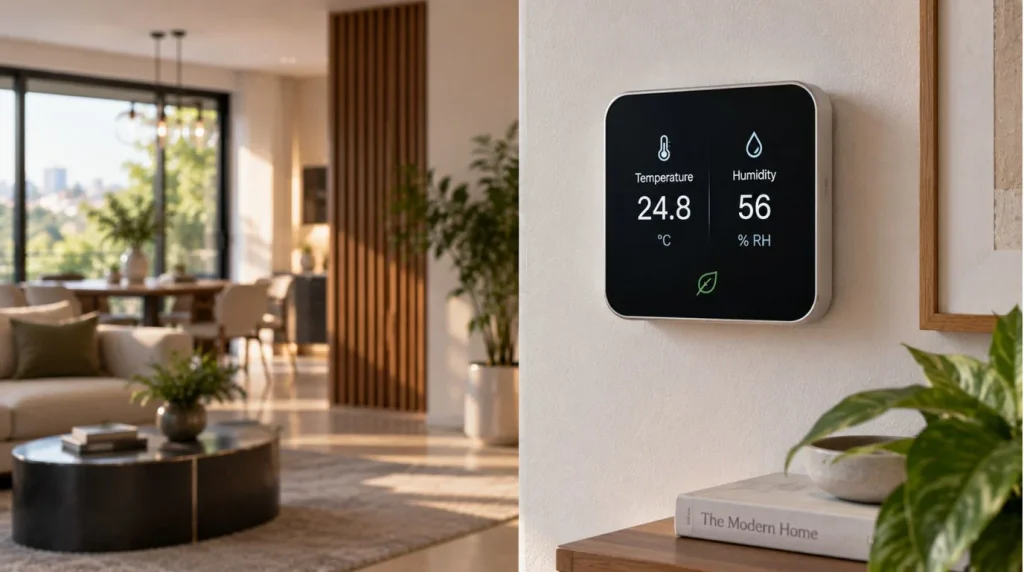
Many homeowners focus almost entirely on temperature. People often ignore humidity until the indoor environment starts feeling uncomfortable. High humidity can make warm temperatures feel even warmer and can contribute to a damp or stuffy feeling.
Too much indoor moisture can create poor conditions for some materials and may cause mold issues if not controlled. On the other hand, dry indoor conditions can also affect comfort.
This is why home automation for humidity and temperature control considers two related but different measurements.
Temperature tells you:
How warm or cool is the air?
Relative humidity tells you:
How much moisture is present in the air relative to its capacity at that temperature?
Together, these measurements provide a much better picture of indoor comfort.
1. Maintain Consistent Room Temperature
One of the biggest benefits of home automation for humidity and temperature control is consistency. Without automation, homeowners often adjust AC settings manually.
The result can be:
- Room becomes too cold
- AC switches off
- Room becomes warm
- AC switches on again
- Someone changes the temperature
- Another person changes it again
Automation can establish predefined temperature targets and operating rules.
For example:
Living Room: 23–24°C
Bedroom: Personalized nighttime setting
Home Office: Comfortable daytime setting
Guest Room: Energy-saving mode when unoccupied
The exact settings should always be based on the homeowner’s preferences and the HVAC system.
2. Control Different Rooms Independently
A large home doesn’t necessarily need the same temperature everywhere. A bedroom may need a different setting from a living room. Someone may occupy a home office during the day while bedrooms remain empty. This makes zoning particularly useful.
With properly designed home automation for humidity and temperature control, different areas can be controlled according to:
- Occupancy
- Time
- Temperature
- Humidity
- Room usage
- User preferences
This can improve both comfort and efficiency. Instead of cooling the entire house equally, the automation strategy can focus on the spaces that actually need conditioning.
3. Automate HVAC Based on Occupancy
Why cool an empty room for hours? Occupancy-based climate automation can help reduce unnecessary HVAC operation.
For example:
Home Office Occupied
→ Maintain preferred temperature.
Home Office Empty
→ Shift to an energy-saving temperature setting.
House Empty
→ Switch the home into Away Climate Mode.
Family Returns
→ Restore preferred comfort settings.
This is one practical advantage of home automation for humidity and temperature control. The system can respond to how the home is being used rather than following a completely fixed schedule.
4. Coordinate Temperature With Motorized Curtains
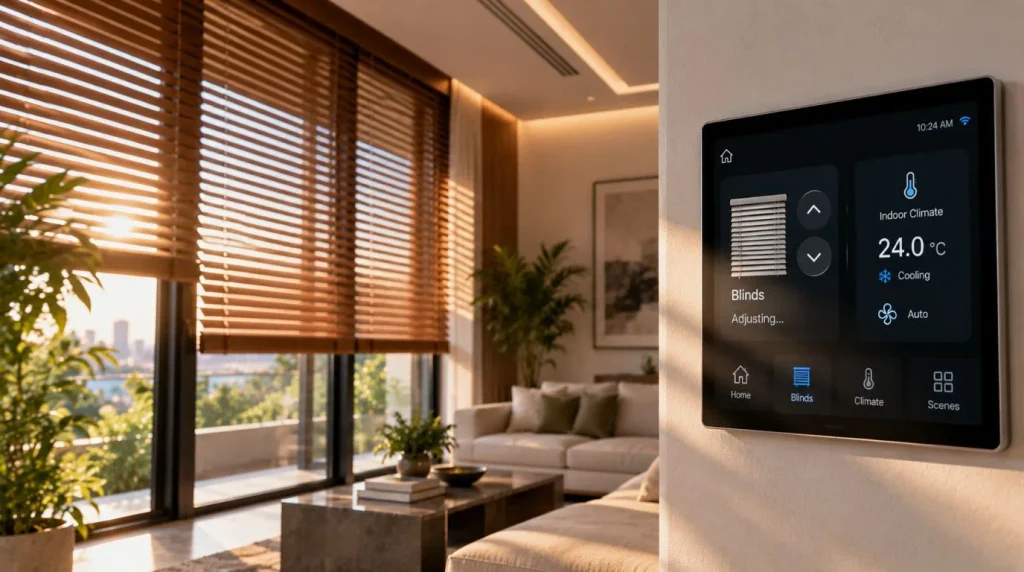
Large glass windows can significantly affect indoor comfort. During strong sunlight, solar heat entering through windows can increase the cooling load. Motorized curtains or blinds can therefore become part of a broader climate strategy.
For example:
High sunlight + rising room temperature
→ Curtains partially close
→ Solar heat gain is reduced
→ HVAC manages the remaining cooling requirement
At other times:
Cooler outdoor conditions + suitable sunlight
→ Curtains open
→ Natural light enters
→ HVAC demand may be reduced
This is where home automation for humidity and temperature control becomes more sophisticated than simply installing a smart thermostat. The system considers multiple elements of the environment.
5. Improve Energy Efficiency
Heating and cooling can represent a significant portion of household energy use. Automation can help reduce unnecessary operation by coordinating climate settings with:
- Occupancy
- Time schedules
- Room usage
- Temperature
- Solar conditions
- Away modes
- Other automation scenes
For example, you do not need to keep the whole home at maximum cooling when people are away.
The system can switch selected zones to an energy-saving mode instead. The goal isn’t to sacrifice comfort. 11111The goal is to avoid wasting energy on spaces that don’t need conditioning. That makes home automation for humidity and temperature control particularly relevant for larger homes with multiple HVAC zones.
6. Create Personalized Comfort Scenes
Automation becomes much more convenient when homeowners don’t have to manage individual smart home devices. Imagine activating a Good Morning Scene.
The system could:
- Open selected curtains
- Adjust bedroom temperature
- Turn on appropriate lighting
- Transition climate settings toward daytime comfort
Or consider Movie Mode:
- Curtains close
- Lighting dims
- HVAC adjusts to the preferred setting
- Entertainment system activates
These scenes demonstrate how home automation for humidity and temperature control can become part of the overall smart-home experience. Climate control doesn’t have to operate separately from the rest of the home.
7. Manage Humidity More Intelligently
Humidity management requires appropriate equipment. Automation by itself cannot remove moisture from the air.
However, home automation for humidity and temperature control can monitor humidity and coordinate compatible HVAC, ventilation or dedicated dehumidification equipment.
Depending on the home’s design, this could involve:
- Humidity sensors
- HVAC systems
- Dehumidifiers
- Ventilation
- Exhaust systems
- Automation controllers
For example, if humidity rises above a set limit, the system can respond if the installed equipment supports it.
This is especially useful in climates where humidity can become a significant comfort consideration.
Temperature vs Humidity: Why Both Matter
| Factor | Temperature | Humidity |
|---|---|---|
| Measures | Warmth/coolness | Moisture level |
| Affects comfort | Directly | Strongly |
| Can be monitored by sensors | Yes | Yes |
| Can influence HVAC automation | Yes | Yes |
| Needs dedicated equipment | HVAC | HVAC/dehumidification/ventilation depending on design |
| Best approach | Maintain preferred setpoint | Maintain appropriate humidity range |
A professional climate-control design considers both rather than treating temperature as the only comfort metric.
What Happens If Humidity Is Too High?
High indoor humidity can make a room feel warmer and less comfortable. It can also contribute to condensation and moisture-related issues when conditions allow. That’s why simply lowering the thermostat isn’t always the best solution.
For example, if a room feels uncomfortable due to high humidity, lowering the temperature a lot may waste energy. It may not fix the moisture issue as well as a good humidity-control plan.
This is another reason home automation for humidity and temperature control should be designed around the actual HVAC and ventilation architecture.
Can Smart Home Automation Control Every AC?
Not necessarily. Compatibility matters. Some air-conditioning systems provide sophisticated control interfaces, while others may have limited integration capabilities.
Before designing home automation for humidity and temperature control, we need to understand:
- AC manufacturer
- AC model
- HVAC architecture
- Communication protocol
- Number of zones
- Existing controls
- Integration requirements
- Future expansion plans
This is particularly important in premium homes where multiple HVAC systems may be installed. Don’t select a smart-home system first and check compatibility later.
KNX and Climate Automation
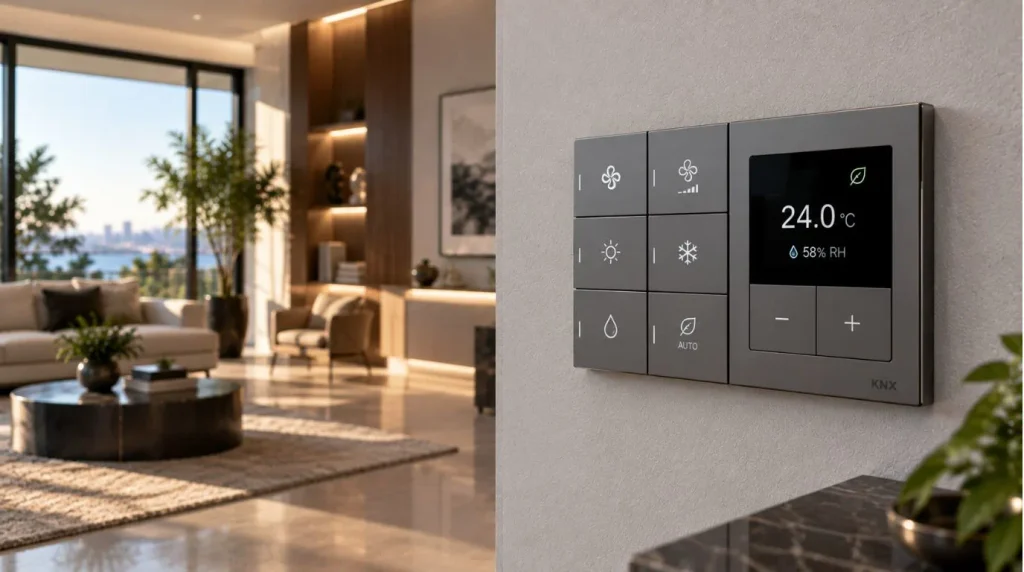
For larger residences, KNX can provide a structured automation backbone for integrating climate control with other building functions.
A KNX-based system can coordinate appropriate HVAC controls alongside:
- Temperature sensors
- Humidity sensors
- Lighting
- Motorized shading
- Occupancy
- Scenes
- Centralized controls
The benefit is not simply “controlling the AC from an app.” The bigger advantage is system-level coordination. For example, the home’s climate strategy can respond to occupancy while shading and lighting operate as part of the same overall automation environment.
Professionals widely use KNX, an open international standard for building automation, in residential and commercial applications.
Smart Thermostat vs Complete Climate Automation
These two concepts are often confused.
Smart Thermostat
Primarily focuses on temperature control and scheduling.
Complete Climate Automation
Can coordinate multiple factors such as:
- Temperature
- Humidity
- Occupancy
- HVAC zones
- Curtains
- Ventilation
- Scenes
- Energy management
| Solution | Best For |
|---|---|
| Basic thermostat | Simple temperature scheduling |
| Smart thermostat | Connected temperature management |
| Zoned HVAC control | Multi-room temperature control |
| Integrated climate automation | Premium homes and complex HVAC systems |
If you have a small apartment with one AC, a smart thermostat or compatible controller may be enough. If you have a large villa with multiple zones, integrated home automation for humidity and temperature control can offer significantly more flexibility.
Common Mistakes Homeowners Make
1. Focusing Only on Temperature
Humidity can be just as important for perceived comfort.
2. Automating Without HVAC Planning
Automation should work with the installed HVAC system, not fight against it.
3. Ignoring Sensors
Without accurate environmental information, automation becomes guesswork.
4. Cooling Empty Rooms
Schedules and occupancy logic can help avoid unnecessary energy consumption.
5. Treating Every Room the Same
Different spaces have different occupancy and comfort requirements.
6. Installing Technology After the Interiors
Sensor positions, HVAC controls, curtain motors, and wiring should ideally be considered during planning.
Our Approach at Techtastic
At Techtastic, we treat climate automation as part of the home’s overall architecture.
Before recommending home automation for humidity and temperature control, we consider:
- Property size
- Number of rooms
- HVAC type
- Number of AC zones
- Existing electrical infrastructure
- Window exposure
- Curtain requirements
- Occupancy patterns
- Desired comfort levels
- Future automation requirements
We then determine how temperature and humidity monitoring should interact with the rest of the home. The result should feel simple to the homeowner even when the technology behind it is sophisticated.
Key Takeaways
If you’re considering home automation for humidity and temperature control, remember:
- Temperature and humidity are different aspects of indoor comfort.
- Automation can monitor both when you install suitable sensors.
- HVAC can be coordinated with occupancy and schedules.
- Different rooms can have different climate requirements.
- Motorized curtains can support temperature management.
- Humidity control may require dedicated HVAC, ventilation, or dehumidification equipment.
- Smart thermostats are not the same as complete climate automation.
- KNX can provide a structured platform for professional climate integration.
- Good sensor placement and HVAC compatibility are essential.
- The best system focuses on the property rather than a collection of individual gadgets.
Frequently Asked Questions (FAQs)
1. What is home automation for humidity and temperature control?
Home automation for humidity and temperature control uses sensors, HVAC controls, and automation logic to monitor and manage indoor environmental conditions according to predefined requirements.
2. Can home automation control humidity?
Yes, when you install appropriate humidity sensors and compatible HVAC, ventilation, or dehumidification equipment. Automation can coordinate the equipment based on humidity readings.
3. Does a smart home automation system reduce AC electricity consumption?
It can help reduce unnecessary HVAC operation through scheduling, occupancy-based control, zoning and energy-saving modes. Actual savings depend on the home and HVAC system.
4. Can automation control different temperatures in different rooms?
Yes, provided the HVAC system supports appropriate zoning or individual-room control.
5. Can curtains help with temperature control?
Yes. Motorized curtains or blinds can work with sunlight and climate plans. They help control solar heat that enters the home.
6. Is a smart thermostat enough for a luxury home?
It can be sufficient for simple HVAC requirements. Larger luxury homes with multiple zones and integrated systems can benefit from more comprehensive climate automation.
7. Can KNX control HVAC?
KNX can integrate HVAC controls and coordinate them with other building automation functions like lighting, shading, occupancy, and scenes.
8. What humidity level should a home maintain?
There isn’t one universal setting for every home or climate. Appropriate humidity targets depend on local conditions, HVAC design and occupant comfort. The automation strategy should be developed accordingly.
9. Can home automation for humidity and temperature control work with existing ACs?
Potentially. Compatibility depends on the AC model, control interface, and overall HVAC architecture. Complete a professional assessment before selecting an integration method.
10. Is climate automation useful in Indian homes?
Yes. Indian homes can experience substantial seasonal changes in heat and humidity, making intelligent HVAC and environmental control useful, particularly in premium residences with multiple climate zones.
Collaboration Opportunities for Architects & Interior Designers
Climate automation should ideally be considered during the architectural and MEP planning stage.
Architects and interior designers can work with Techtastic to coordinate:
- HVAC zoning
- Temperature sensor locations
- Humidity sensor locations
- Curtain pockets
- Motorized blinds
- Smart switches
- Control panels
- Equipment spaces
- Network infrastructure
- Concealed wiring
This approach prevents automation from becoming an afterthought.
For luxury residences, home automation for humidity and temperature control should be integrated into the design so that the technology remains discreet while the comfort benefits are immediately noticeable.
Areas We Serve
Techtastic works with homeowners, architects, interior designers, builders and developers across: Navi Mumbai | Nashik | Lonavla | Sangli
We design integrated smart-home and climate-control solutions for premium apartments, villas and residential projects.
Final Verdict
Home automation for humidity and temperature control is ultimately about making indoor comfort more intelligent. Instead of changing AC settings manually, homeowners can use sensors and HVAC controls. They can also use occupancy data, motorized curtains, and automation scenes.
This helps create a more consistent indoor environment. But good climate automation isn’t about making the AC run more often.
It’s about running the right systems at the right time, in the right rooms, based on actual conditions.
For a premium home, that can mean greater comfort, better control, and potentially more efficient HVAC operation. And when designed correctly, Home Automation for Humidity and Temperature Control becomes almost invisible.
You simply walk into the room—and it already feels right.
Contact Techtastic
🌐 Website: Techtastic Website
📞 Phone: 9769145145
📍 Service Areas: Mumbai • Navi Mumbai • Pune • Lonavala • Nashik • Sangli