
Summary
In the brutal Indian summer, your windows are like heaters; trapped heat makes your rooms feel like a greenhouse. Most people crank up the AC, but the real secret is stopping the heat before it gets inside.
Electric curtains do more than look luxurious; they are energy-saving tools. By syncing with the sun’s movement, they close automatically during the hottest parts of the day.
The Result:
- Lower Temperatures: Your rooms stay naturally cooler.
- Smarter Savings: You reduce your dependency on the AC.
- Total Convenience: No more running around to pull drapes when the sun hits.
This guide explores how smart curtains serve as a functional investment in sustainable luxury and year-round comfort.
Cool Your Home for Less: The Energy-Saving Magic of Electric Curtains
I’ve spent a lot of time in beautiful bungalows across Delhi, Navi Mumbai, and Lonavla, and there is one recurring theme every summer: the battle against the sun. We spend months planning our interiors, choosing the perfect marble and the finest upholstery, only to spend the months of April through June hiding behind drawn curtains while the air conditioner works overtime.
Usually, when we think about “cooling,” we think about bigger AC units or faster fans. But as someone who works deeply with hybrid smart home systems, I look at it differently. I look at the windows.
Windows are the biggest “thermal leaks” in any house. Even the most expensive double-glazed glass will heat up under the Indian sun. If you wait until the room feels hot to close your curtains, you’ve already lost the battle.
The magic is simple: stop the heat before it enters. This transforms electric curtains from a luxury into a vital energy-saving tool.
The Greenhouse Effect in Your Living Room
We’ve all experienced it: you walk into a room that has been closed up all day, and it feels five degrees hotter than the rest of the house. Solar radiation enters through the glass, hits your furniture and floor, and converts into heat. Your home then traps this heat.
When you finally turn on the AC, it has to work twice as hard to “flush out” that trapped heat before it can even start cooling the air. Electric curtains change the game by being proactive rather than reactive.
1. Solar-Tracking: The Proactive Shield
The most powerful way to save energy is to automate your curtains based on the sun’s position. In a smart home, your curtains don’t just sit there; they “know” the time of day.
Imagine your east-facing bedroom curtains closing automatically at 8:00 AM as the sun rises, and then opening at noon once the sun has passed over the roof. Meanwhile, your west-facing living room drapes stay open all morning but slide shut at 3:00 PM just before the harsh afternoon glare hits. By the time you get home from work, your house is naturally 3 to 4 degrees cooler, allowing your AC to reach a comfortable temperature in half the time.
2. Thermal Layering and Insulation
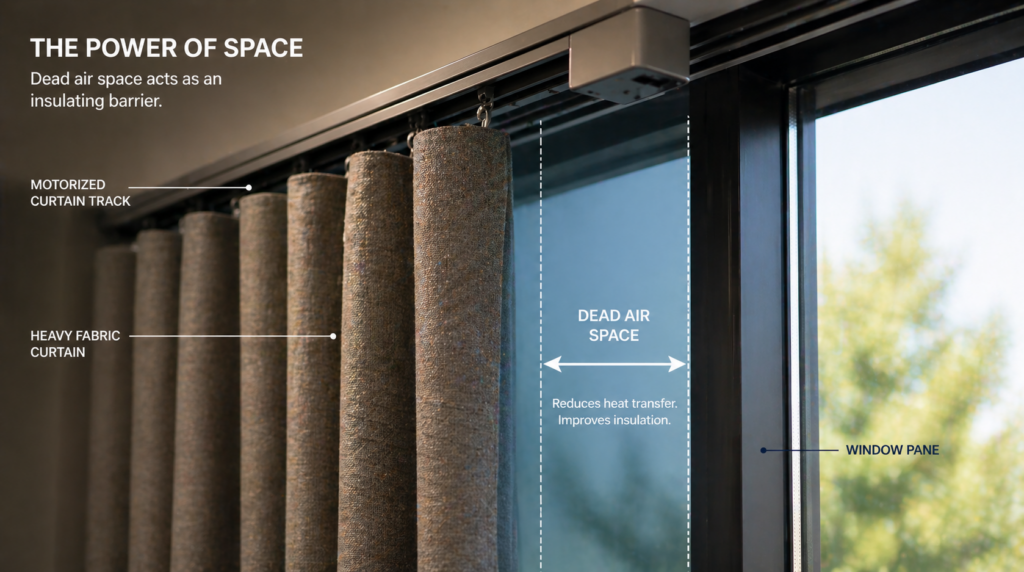
Most people think of curtains as a privacy tool, but they are actually a thermal barrier. When your electric curtains are closed, they create a pocket of “dead air” between the glass and the fabric. This air acts as an insulator.
At the peak of summer, this barrier keeps the heat out. Surprisingly, in the cooler winter months of North India, this same barrier helps maintain the warmth inside, preventing your room heaters from running constantly – a year-round Return on Investment (ROI) that appears directly on your electricity bill.
3. Protecting Your High-End Interiors
Energy isn’t the only thing you save. Intense UV rays are the primary cause of fading for expensive wooden flooring, silk drapes, and leather sofas. I’ve seen beautiful homes in Nashik where the polish on the teak furniture starts cracking simply because of sun exposure.
By using electric curtains to block the sun during peak hours, you are essentially “sun-screening” your home. You’re extending the life of your furniture and decor, saving you the massive cost of re-polishing or re-upholstering every few years.
4. The Convenience of “One-Touch” Control
Let’s be honest: if you have a house with ten or fifteen large windows, you probably don’t walk around closing all of them manually every afternoon. You might close one or two, but the rest stay open, letting the heat in.
With a centralized hybrid smart home system, you can close every single curtain in your house with one tap on your phone or a single voice command. When something is this easy, you actually use it. And when you use it consistently, the energy savings become real and measurable.
5. Integration with Your AC
This is where the real “magic” happens. In a truly smart home, your curtains and your AC “talk” to each other.
If your AC is running but the room temperature isn’t dropping fast enough, the system can check the status of the curtains. If it’s 2:00 PM and the curtains are open, the system can automatically glide them shut to help the AC do its job. This synergy ensures that your cooling system is always running at peak efficiency.
Final Thoughts: Luxury That Pays for Itself
We often view home automation as an indulgence, but as energy costs continue to rise and our summers get longer, smart cooling is becoming a necessity. Electric curtains offer a rare combination: they make your life significantly more comfortable while making your home more sustainable.
If you are a builder, architect, or homeowner in Navi Mumbai, Nashik, or Lonavla, let’s look at your window plan.
Do you have a large west-facing window that makes your living room unbearable in the afternoon? That’s the perfect place to start.
Collaboration Opportunities for Builders and Architects
I work with developers, architects, and interior designers to enhance residential projects by integrating electric curtains during the planning and design stages. My team ensures that automation aligns seamlessly with your design layouts, electrical infrastructure, and interior concepts.
I invite you to partner with Techtastic to implement high-quality electric curtains for your upcoming projects in Nashik, Navi Mumbai, Sangli, and Lonavla.
Contact today at 9769145145 for a professional consultation to see how an expert home automation electric curtains system can elevate your design vision.
Technical FAQs
Q: Do electric curtains use a lot of electricity themselves?
A: Not at all. The motors only draw power when they are moving (which is usually just a few seconds a day). Most modern motors are incredibly energy-efficient, and many even have “sleep modes” where they consume almost zero power when idle.
Q: Can I set the electric curtains to open and close even when I’m not at home?
A: Yes! That is the beauty of a hybrid smart home system. You can set a schedule once, and the curtains will follow it every day, regardless of whether you are in Delhi or on vacation in Lonavla.
Q: Will I need to change my existing curtain rods?
A: Usually, yes. Electric curtains require a specialized track that houses the motor and the drive belt. Designers build these slim tracks to fit hidden inside your existing POP (Plaster of Paris) ceiling coves.
Q: What happens if there is a power cut?
A: Most professional-grade tracks (like those we use in high-end bungalows) have a “Manual Override” feature. You can still pull the curtain gently by hand, and it will slide like a traditional curtain without damaging the motor.
Q: How do the electric curtains “know” when the sun is out?
A: We use two methods: either a “Sunrise/Sunset” clock based on your GPS location, or actual solar sensors mounted on your windows that trigger the curtains when the light intensity reaches a certain level.